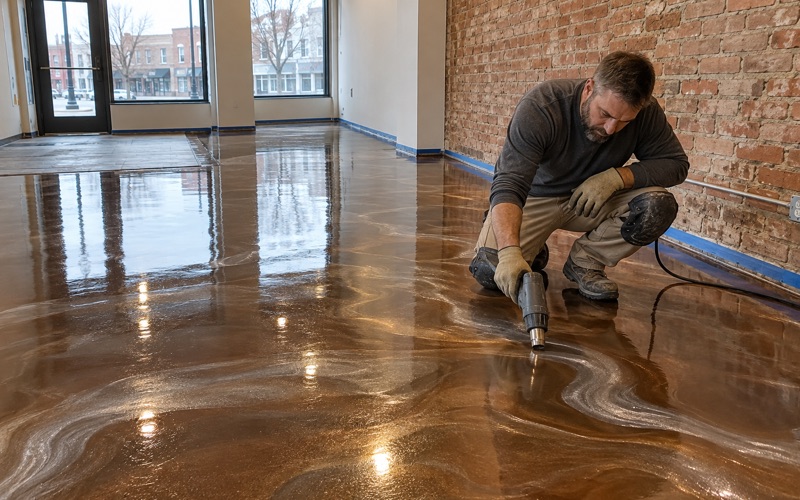
Waukesha Epoxy Flooring has installed epoxy flooring in Brookfield and across the county for more than 20 years, and the floors we are asked about here split two ways: the service lanes where cars arrive straight off the road, and the garages behind owner-occupied homes. Both take tires every day, and both are specified the same honest way.
That way starts with the slab, not the product. We open every floor with a diamond grinder or a shot blaster, never acid, and we test for moisture as a quoted line item before anything is mixed. The proposal names the product, the system build and the finished thickness, so the floor that goes down can be checked against the paper.
A floor where warm tires stop is the hardest test a coating gets, and it is where cheap systems show themselves first. This page walks through how we plan for that on a commercial service drive, what changes in a wash or prep bay, how we fit around a working schedule, and what a Brookfield homeowner should expect in the garage.
Capitol Drive Service Lanes Take Road-Warm Tires All Day
What a Dealership Addition Was Planned Around
Capitol Drive in Brookfield is lined with dealerships, and their buildings are planned around moving customer cars indoors. A 2014 Brookfield staff report, covered by BizTimes that March, described Soerens Ford’s proposed 19,982-square-foot addition to its 30,352-square-foot Capitol Drive dealership. The listed uses were service order intake and write-up, vehicle clean and prep, a new showroom, truck service and car washing.
We do not know whether that addition was built as described, and we have not coated that building. What the report shows is the shape of the work a modern service department expects its floor to carry. Cars are driven in, written up, moved to a stall, cleaned, washed and driven back out, all on concrete under a roof.
The Write-Up Lane Sees Every Car
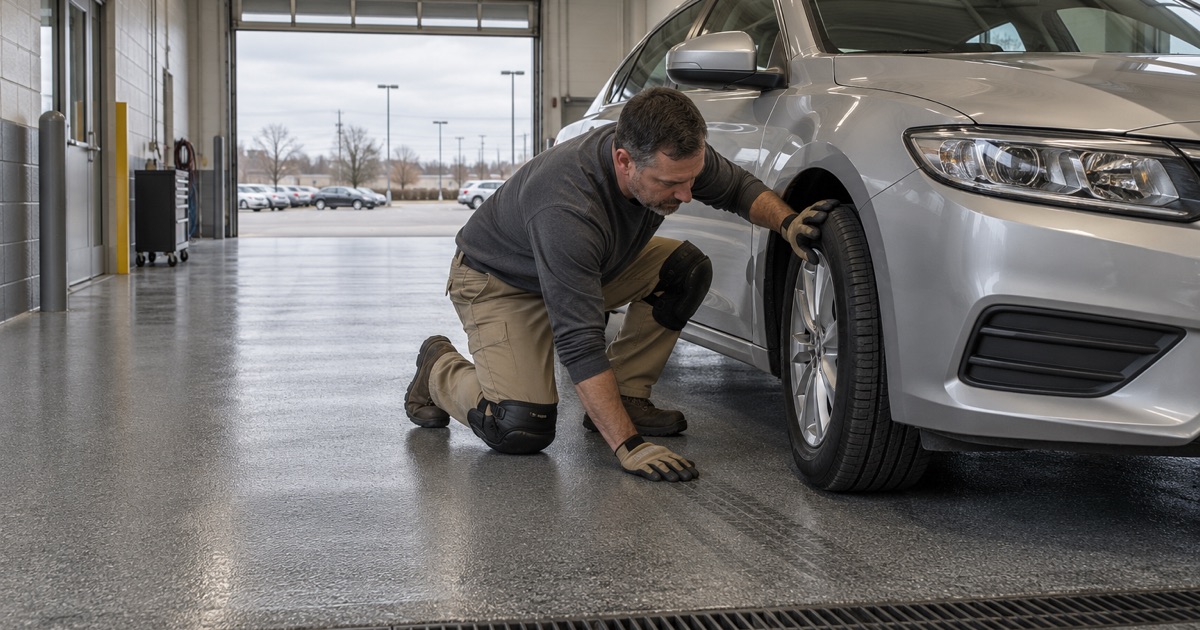
The service drive is where a customer pulls in, stops and waits while an advisor walks around the car. Every one of those vehicles has just come off the road, so its tires are warm when they settle onto the floor. That happens all day, every day the service center is open, in the same few square feet at the head of each lane.
Dealer listings give Soerens Ford’s service hours as 7:00 a.m. to 7:00 p.m. on Monday and Tuesday, 7:00 a.m. to 6:00 p.m. Wednesday through Friday, and 7:00 a.m. to 3:00 p.m. on Saturday. That is a long stretch of warm tires arriving and stopping, and it is the textbook setting for hot tire pickup on a coated floor.
Truck service adds weight to the same problem. A heavier vehicle presses a warm tire harder into the coating, and pickups and work trucks often arrive after highway driving. When we look at a service lane, we treat the intake stop, the turn into a stall and the truck bay as the zones that set the specification for the whole floor.
A coating that fails in a write-up lane fails in front of customers. Lifted patches and tire-shaped marks at the head of each lane are among the first things a buyer sees after parking, so for a dealership the floor is part of the showroom. That is why we want the lane layout, stall positions and traffic pattern before we price anything.
Looking for epoxy-flooring closer to Hartland? See Epoxy-Flooring in Hartland.
Why Hot Tires Lift Weak Coatings
What Happens Under a Stopped Tire
Hot tire pickup works in two steps. A tire warmed by driving softens the coating under it while the car sits, and the plasticizers in the rubber can soften it further. As the tire cools, its footprint contracts and grabs the film, and when the car pulls away a weakly bonded coating can come up with it, leaving a bare patch.
Trade sources are fairly consistent that the tire is only the trigger. They put most failures on the system: the product chosen, the film build, the surface preparation and the cure. A thin, single-coat roll-on over a smooth, acid-etched slab is the classic case, and it fails on a dealership floor long before it would in a lightly used garage.
How We Specify a Service Floor
For a service drive we lean toward a 100% solids epoxy base at a real film build, broadcast with quartz aggregate where traction matters, and finished with a polyaspartic or polyurea topcoat chosen for heat and chemical resistance. Where a lane sees heavier trucks or hot water, a urethane cement system can be the better answer, and we say so.
Whatever the build, the proposal states it in writing: the product, the number of coats, the broadcast and the finished thickness. A service manager can hold that page up against the floor after we leave. We also read the warranty exclusions aloud before the job is sold, and moisture coming up through the slab is the first one we name.
Bond Starts With an Opened Slab
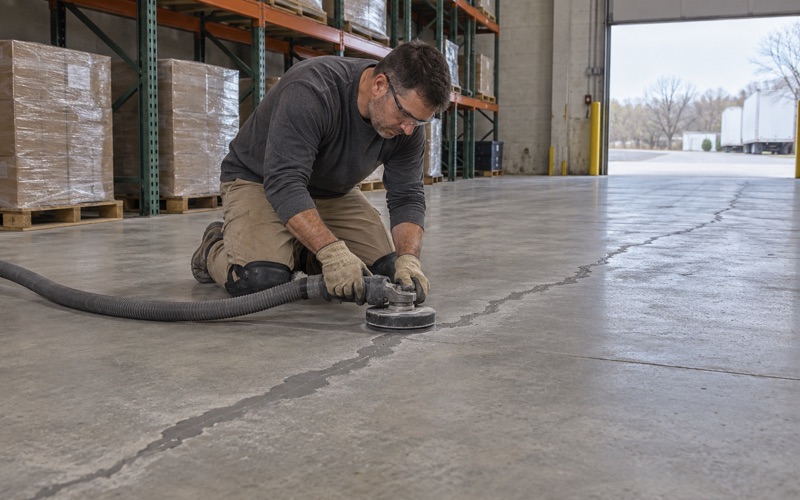
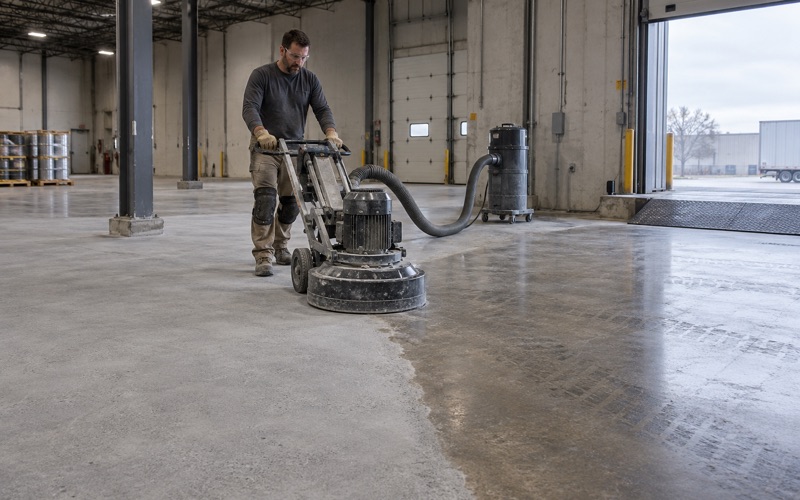
Most hot tire pickup we are called to look at began with preparation. We profile every floor mechanically, by diamond grinding or shot blasting, to a measured ICRI concrete surface profile, and we never acid etch. Before quoting we also read the cracks, joints and any old coating, and we tell an owner plainly when a section needs repair first.
Even a well-built system is not immune. A tire fresh off a long drive can still mark a floor, and no installer can honestly promise otherwise. What the right system does is keep the film bonded to the concrete, so a mark stays a mark instead of becoming a lifted patch that spreads every time the next car stops.
Wash Bays, Prep Areas and a Service Department’s Hours
Clean and Prep Floors Stay Wet
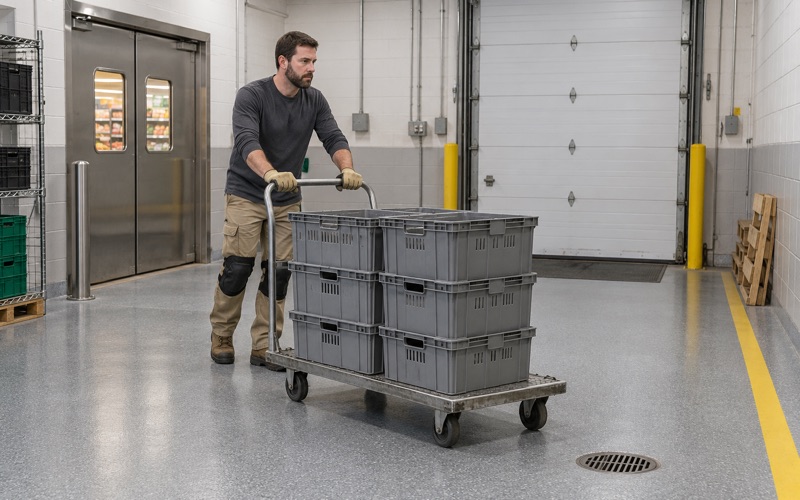
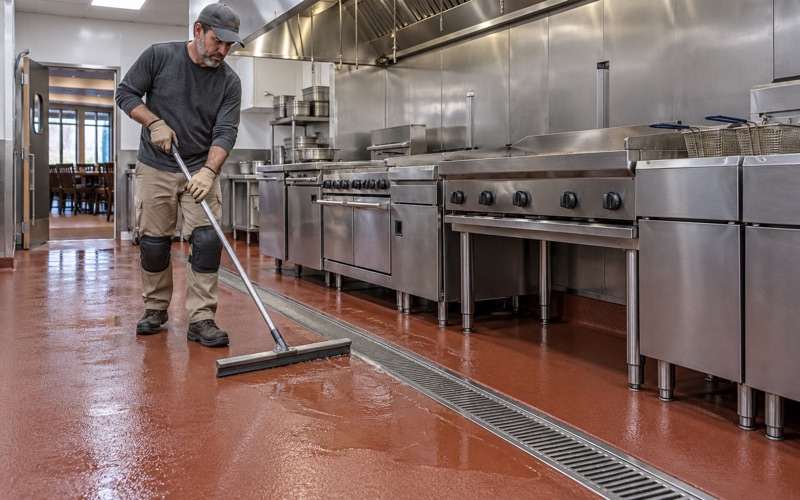
The same 2014 report listed vehicle clean and prep and car washing among the addition’s uses, and those floors have a different job from the write-up lane. A car wash bay is wet for most of the day, carries soap and road grime, and runs water toward a drain. Slip resistance and a coating that tolerates standing water come first.
For a wash or prep bay we build traction into the broadcast rather than relying on a smooth gloss, and we keep the finish following the slab’s fall so water moves to the drain. Joints and cracks are filled with a semirigid filler before any coating crosses them, so cart and dolly wheels do not chip the edges and open a path for water.
Winter adds its own load. Cars come into a Brookfield service lane carrying road salt and calcium chloride brine on their tires and undercarriage, and that melts onto the floor and dries into a crust. We specify topcoats for that chemical exposure and tell a service department which cleaners keep the finish intact through a season.
Overnight and Sunday Work Windows
A service department that opens at 7:00 a.m. six days a week cannot give up its lanes on a weekday. With dealer listings showing the service center closed on Sunday, the realistic windows are overnight and the stretch from Saturday afternoon to Monday morning. We plan grinding, coating and cure in sections so lanes come back in a set order.
Cure is scheduled against slab temperature and the dew point spread at the surface, not against the calendar. A cold slab in January cures more slowly than the same product in June, and coating too close to the dew point invites amine blush. If a section needs more time before traffic, we tell the manager before the job starts, not after.
Dust, Slurry and Air Quality
Grinding dust and wash slurry are collected on site and never sent into a floor drain or a storm sewer, which matters in a building full of trench drains. The Capitol Drive dealership addresses also lie north of I-94 and east of Highway 67, inside the part of Waukesha County included in the Milwaukee 2015 ozone nonattainment area.
Wisconsin has no state architectural-coating VOC rule, so the federal 40 CFR 59 Subpart D national rule is the baseline for the products we bring in. On a service floor that reopens the next morning, low-odor, high-solids materials also make practical sense, since advisors and customers will be back in the building when the lanes reopen.
Brookfield Garage Floors
Mostly Owner-Occupied Detached Homes
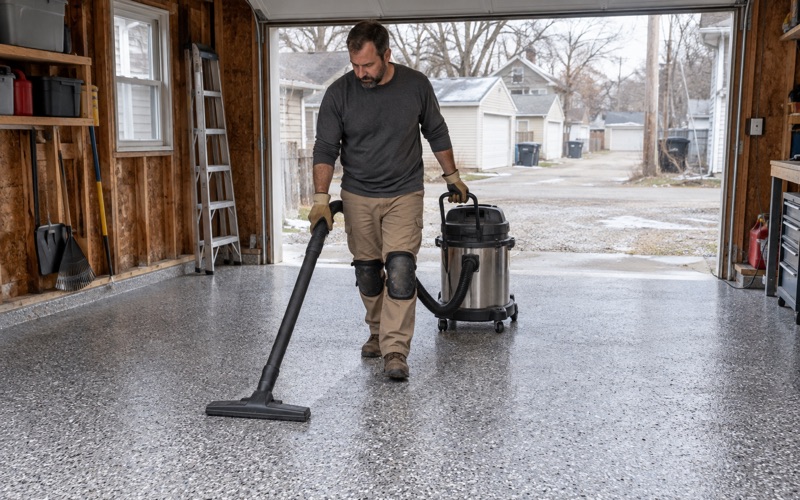
Most of our residential work here is in garages. Census figures count 12,015 owner-occupied detached homes among the city’s 13,354 owner-occupied units, so the typical customer owns a single-family house and parks on its slab. Those garages see the same warm tires on a smaller scale, every time a car comes home from the highway and sits overnight.
The housing stock leans older than many suburbs. More of Brookfield’s housing units were built in the 1950s than in any other decade, with more than 2,800 added in the 1960s and steady building through the 1990s. An older garage slab may carry decades of oil, sealers or a previous coating, and all of it has to come off before a new system can bond.
Moisture Testing Comes First
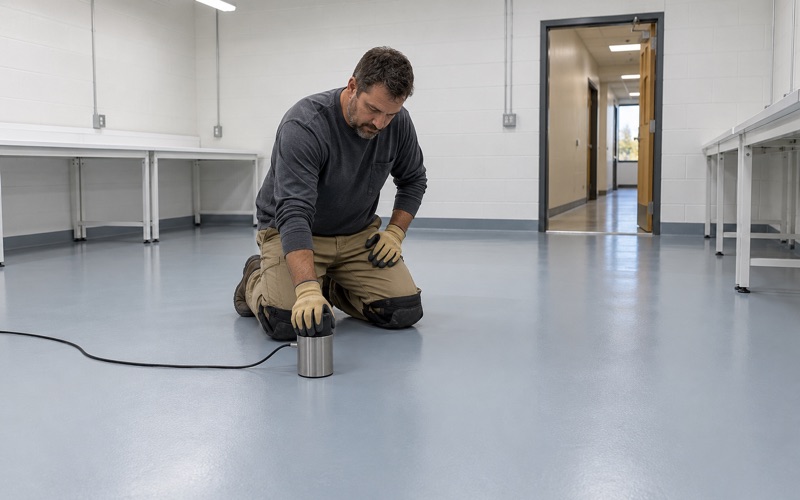
Wisconsin does not require a vapor retarder under an unconditioned attached garage slab, so a dry-looking floor proves very little. We test before we coat, using a plastic sheet test, calcium chloride emission testing or in-situ relative humidity probes as the slab calls for. A coating is not a radon reduction system and will not stop water coming up through concrete.
Permits, Contracts and the Right City
Coating a slab and replacing one are different questions, so we ask before we schedule. The City of Brookfield is its own jurisdiction, with community development and building inspection at City Hall, 2000 N. Calhoun Road, and the Town of Brookfield next to it is a separate one. We confirm which side of that line a home sits on first.
Every home job gets a written contract before any deposit, naming the products and any warranty. If a project grows into slab replacement that needs a one- or two-family permit under the Wisconsin Uniform Dwelling Code, it is pulled by a holder of the Wisconsin Dwelling Contractor certification. Unheated garages in deep winter may have to wait for spring, and we say so plainly.
- 20+ Years Coating Concrete
- Moisture Testing in Every Scope
- Written Contract Before Any Deposit