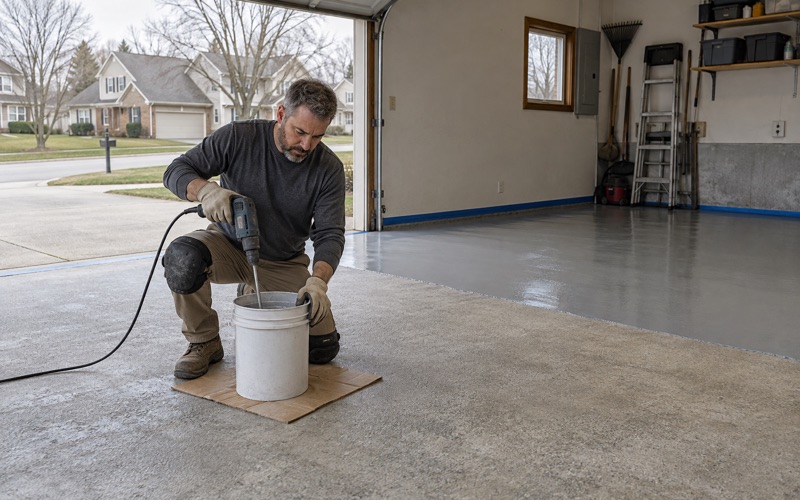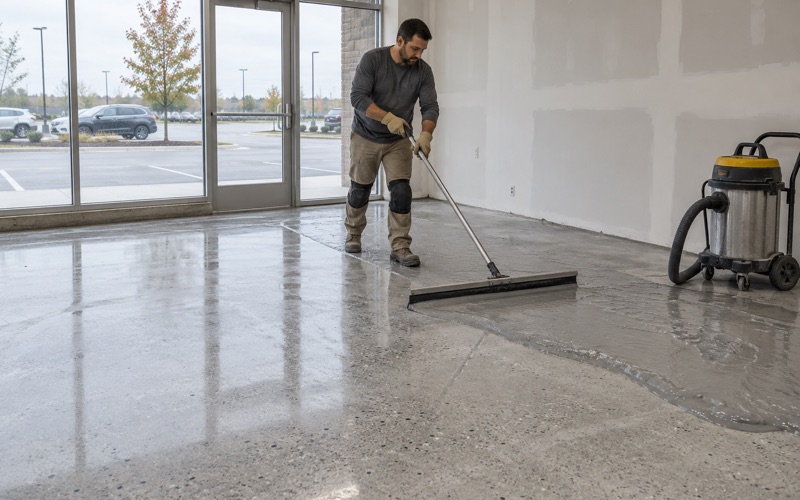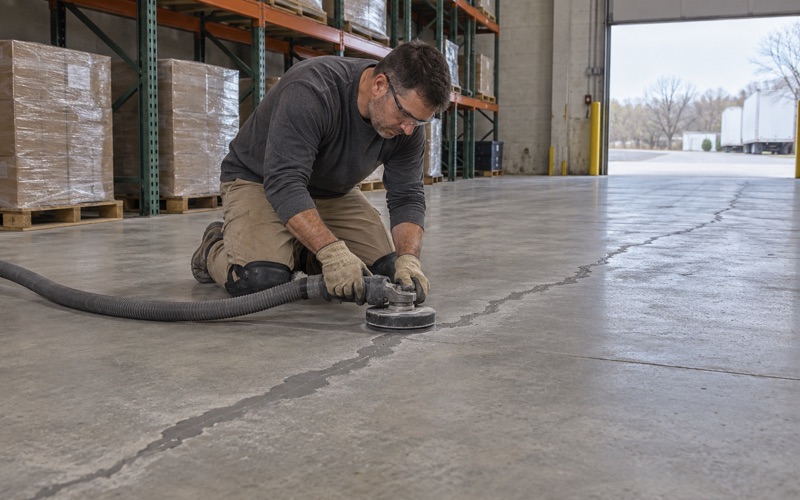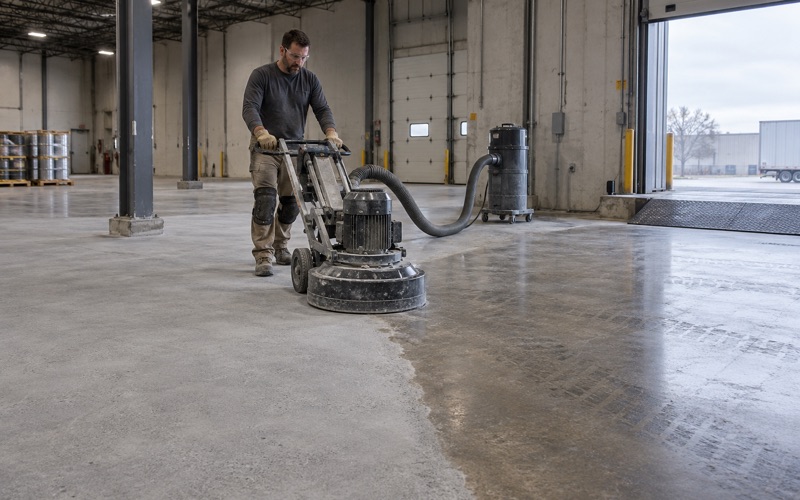
Waukesha Epoxy Flooring brings more than 20 years of grinding, testing and coating concrete to epoxy flooring in Brown Deer, and every job begins with the slab rather than the color chart. We open each floor with a diamond grinder or shot blaster before anything is applied, and we never acid etch. Coatings tend to fail at the bond line long before the film wears through, so the bond gets our attention first.
That holds whether the floor sits under a workshop, a small retail space, a basement or a two-car garage. Before we price anything, we read the cracks, the joints and whatever coating is already down. If a slab needs repair or replacement before it can carry a coating, we say so plainly instead of quoting a system we expect to peel.
The written proposal names the product, the way the system is built and the finished thickness, so the installed floor can be checked against what was quoted. Moisture testing sits in that scope as its own line from the start. Much of this page is about commercial floors in the village’s older business district, where a change of tenant comes with a public approval attached.
Brown Deer’s Original Village and Its Development Agreements
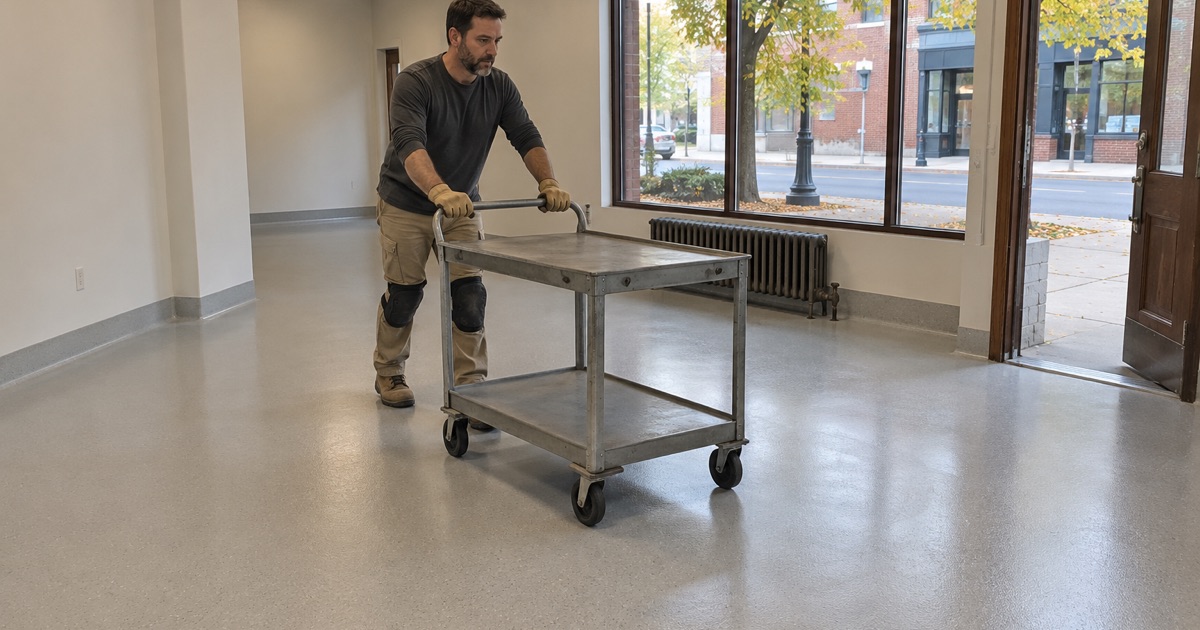
The Original Village lies south and west of the Brown Deer Road and Green Bay Road intersection, and it is the village’s only downtown. Brown Deer incorporated in 1955 to prevent annexation by Milwaukee, and the old crossroads is where recent redevelopment has concentrated: 134 new apartments, a 1930s church and school razed for 175 units, and a Community Square.
The intersection itself was rebuilt as a $20 million at-grade crossing, replacing a freeway-style overpass, and the village has set up a new tax increment district. Its comprehensive plan lists main-street shopping in the Original Village as a strength and names redeveloping the area into a local destination as a goal. Small storefronts change hands as that work plays out, and each change raises the question of the floor.
Why each business there has its own agreement
In most suburban business districts, a new tenant checks the zoning table, confirms the use is permitted and moves in. The Original Village works differently. A December 2021 village staff report put it directly: ‘Because the property is located in the Original Village neighborhood, a development agreement is required to govern the land use.’ The rule it cited is Village Code Chapter 121-250.
That agreement is how the village shapes the way one business uses one building in a district it is actively rebuilding. Each one goes before the Plan Commission and then the Village Board, and its terms are written for that occupant. The village’s Community Services application lists a $350 fee for a development agreement and $150 for modifying an existing plan, agreement or permit.
The requirement quoted in that report is tied to the Original Village neighborhood. A shop on another Brown Deer corridor may face a different review entirely. Inside the district, though, the agreement is what defines the business on paper, and any floor we put down has to suit the use that document describes.
Who runs the process
The Village of Brown Deer Community Services Department, at Village Hall on West Green Brook Drive, handles these applications along with rezoning, conditional use permits and site and operational plans. We do not negotiate agreements or file them for a tenant. That conversation belongs to the business, the property owner and the village, and the agreement governs land use, not floor materials.
Looking for epoxy-flooring closer to Glendale? See Epoxy-Flooring Services in Glendale.
What an Agreement Records, and Why the Floor Carries the Business
The clearest example on the public record is the Plan Commission packet for December 13, 2021. It describes Fabric Lab, a dye-sublimation textile printer seeking to lease and occupy the former Modus Design at 8759 N. Deerwood Drive. Dye sublimation applies an image to textile, and the business described taking work from design to finished textile under one roof on a 0.120-acre parcel zoned G3 Commercial.
Hours, staff and alterations
The staff report recorded three employees and hours by appointment. It stated that the majority of business activity would be handled within the building, with no exterior storage, and that the owner was not proposing any building alterations at that time. Those are the kinds of terms an Original Village agreement sets down, and they shape what a floor contractor can schedule in the space.
We cite that record to show how the district works, not as a job of ours, and we have not checked who occupies the building today. The lesson for any tenant in a similar position is that hours, staffing and building changes are part of a negotiated use. Floor work should be planned with those terms in view rather than around them.
No exterior storage puts everything on the slab
A clause like no exterior storage reads as paperwork until you ask where the inventory goes. With no yard, no trailer and no outdoor rack, every roll of fabric, carton, press, cart and pallet of supplies sits on the shop floor. In a small building, that one slab becomes the stockroom, the production line and the shipping area at the same time.
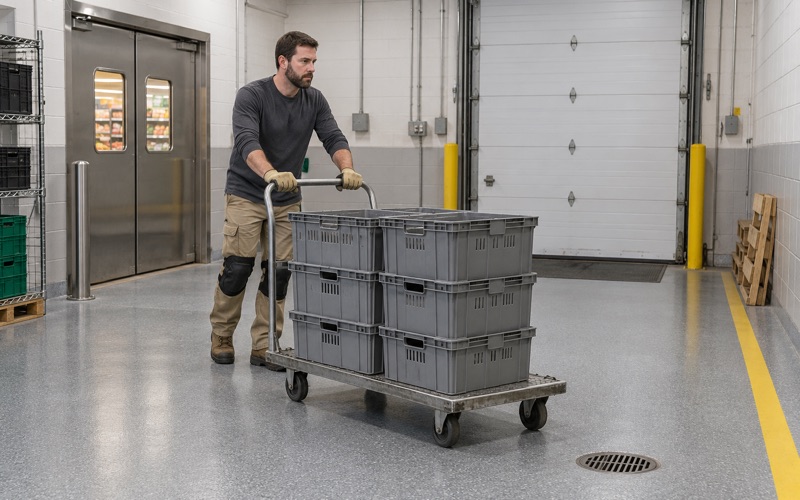
That changes what we specify. Pallet jacks and loaded carts pivot in the same tight aisles all day, so control joints are filled with a semirigid joint filler before any coating crosses them, which keeps wheels from breaking the edges. A 100% solids epoxy body with a quartz aggregate broadcast builds a dense, textured film that stands up to heavy equipment feet far better than a thin rolled-on paint.
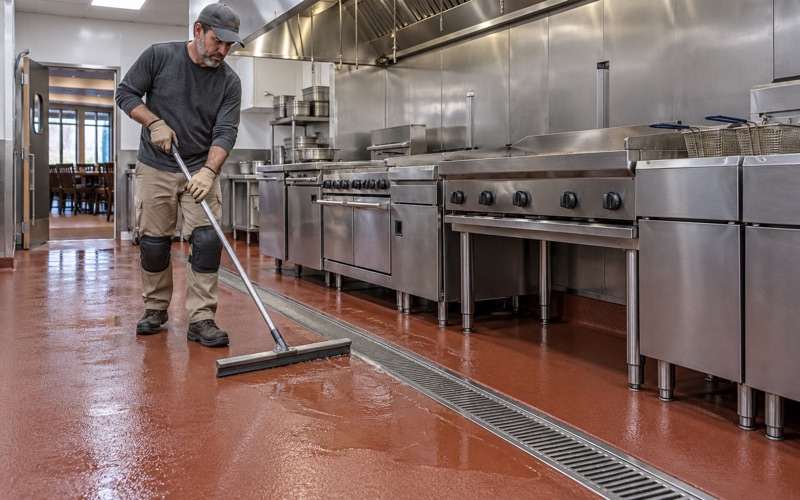
Inks, dyes, adhesives and cleaners end up on the floor of any print or craft shop. A polyaspartic or polyurea topcoat over the epoxy resists staining, wipes clean and holds its finish under rolling traffic. Where a tenant runs sensitive electronics, we can walk through static-dissipative or ESD flooring and the resistance range the equipment maker calls for.
Color and finish in a crowded room
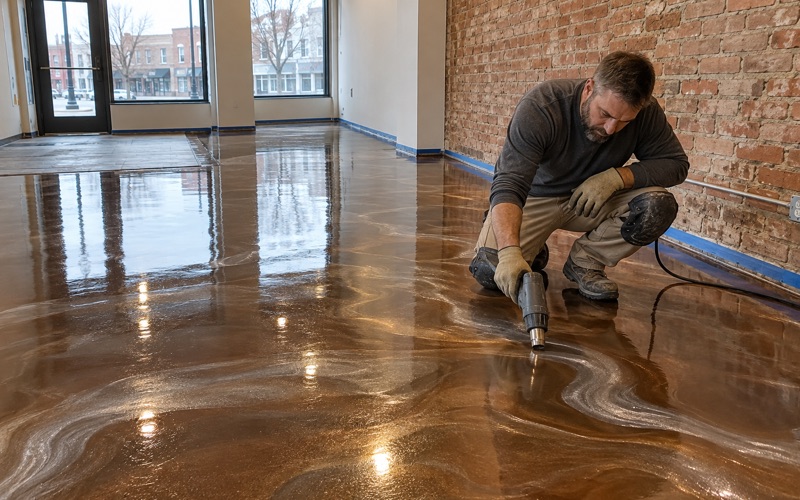
When all of the stock lives indoors, a lighter floor makes a small room easier to work in and makes a dropped screw or blade easier to spot. A vinyl flake broadcast hides dust and scuffs between cleanings, while a solid color with fine quartz shows the workspace more clearly. We bring samples so the choice gets made on the actual slab, under the actual lights.
Planning Floor Work Around a New Tenant’s Approval
A floor in a building that is waiting on an agreement has a natural sequence. The tenant applies, the Plan Commission reviews the request, the Village Board acts, and only then is the use settled. We like to price the floor early so the business knows the cost, then schedule the install once approvals are in place and the previous occupant’s equipment is gone.
Ask before the job, not after
Coating an existing slab and replacing one are different questions for an inspector, and an agreement that recorded no building alterations may matter if the scope grows. We ask the village whether a job needs a permit before it goes on the calendar. If drawings are required, the village’s project review checklist asks for a floor plan of the building or addition.
Homeowners in the district should also know that Brown Deer’s application form carries a separate $150 category for an Original Village Residential Building Expansion. A garage or basement coating is not an expansion on its own. When a floor is one part of a larger addition, though, it pays to raise that category with Community Services early.
Moisture and preparation on an older storefront slab
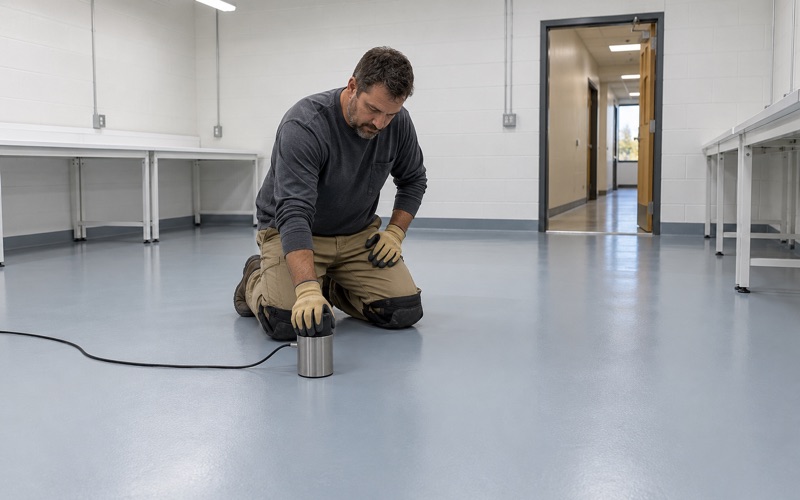
Small commercial slabs have often spent decades under carpet, tile or old paint. We remove what is there and grind to an ICRI CSP profile that suits the system, collecting the dust and slurry on site rather than washing anything into a floor drain. Then we measure: ASTM F2170 in-situ relative humidity probes and ASTM F1869 calcium chloride tests show what the slab is actually releasing.
If the readings run high, a moisture-mitigation primer goes into the scope ahead of the epoxy, or we recommend the floor wait. Our warranty exclusions are read out before a job is sold, with moisture from below named first. A coating does not fix water coming up through a slab, and we will not sell one as if it did.
Working around hours and air rules
An appointment-only shop has more flexibility than a retail counter, but most tenants still want the floor done quickly. We book overnight and weekend windows where a building has to keep running. Cure is timed to slab temperature and the dew point spread at the surface rather than a calendar date, which is how amine blush and soft, tacky coatings are avoided.
Milwaukee County is listed in whole in the Milwaukee 2015 ozone nonattainment area, reclassified as Serious in January 2025. Wisconsin has no state architectural coatings VOC rule, so the national 40 CFR 59 Subpart D limits govern what we apply. High-solids systems keep solvent content low, which also suits a small storefront with limited ventilation.
Original Village Storefront Floor Questions
Business owners and landlords in the district tend to ask a similar handful of things before a tenant moves in. These are the answers we give most often.
Does the development agreement decide what floor we install?
No. The agreement governs how the property is used: the type of business, its hours, staffing, storage and any alterations. The floor system is chosen by the owner or tenant based on what the space has to carry. Our part is matching the coating to the use the agreement describes, so a printer, a studio or a small repair shop each gets a floor built for its own work.
Can the floor go in before the Village Board acts?
It can, but we usually advise waiting unless the property owner is coating the space for any future tenant. If the proposed use shifts during review, the floor may no longer suit it. Pricing early and installing after approval ties the decision to a settled business and avoids paying twice for a floor designed around the wrong plan.
How long will the shop be out of use?
That depends on the system and on the slab. A typical sequence is grinding and repair first, then the base coat and broadcast, then the topcoat, with light foot traffic before carts and heavy equipment return. Because cure follows slab temperature rather than the schedule, we give a range in the proposal and confirm it once moisture readings are in.
What about homes in the village?
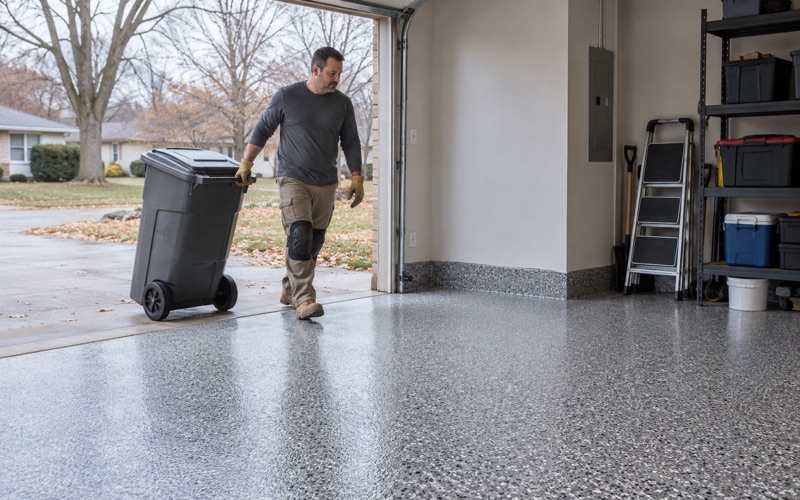
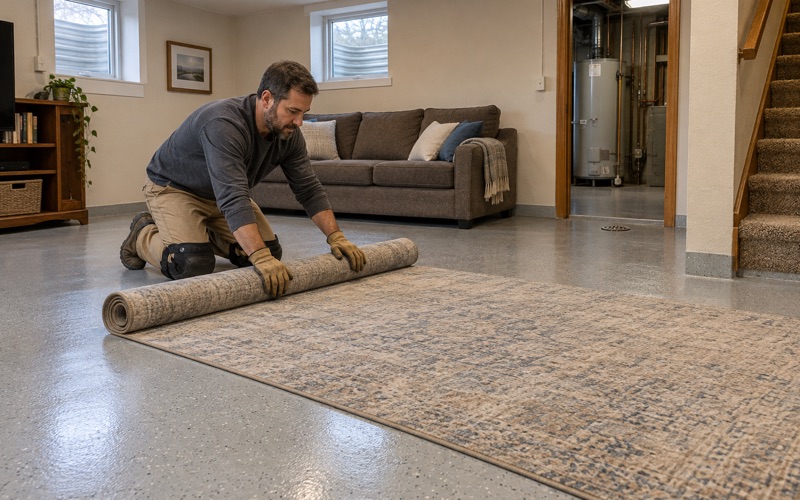
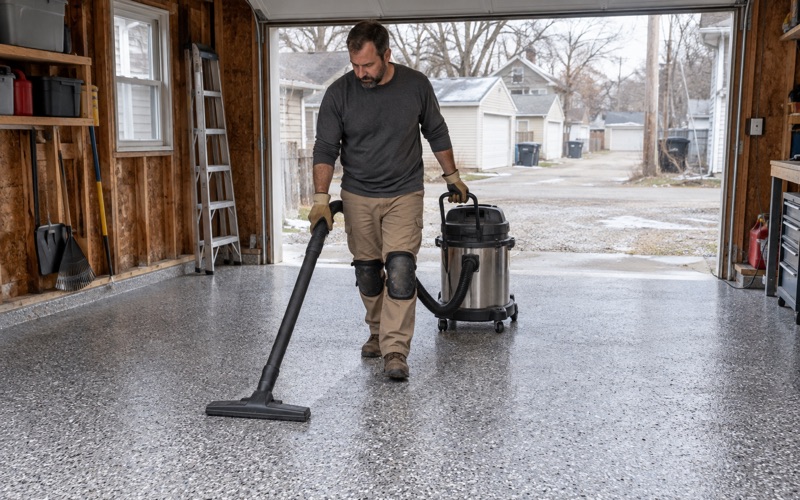
Most of our Brown Deer work outside the business district is garages and basements. Garage floors are built for the road salt and calcium chloride brine that rides in on tires every winter, and an unheated garage may need to wait for spring before the slab is warm enough to cure. Every home job gets a written contract under ATCP 110 before any deposit is taken.
- 20+ Years Coating Concrete
- Moisture Testing in Every Scope
- Written Contract Before Any Deposit