
Waukesha Epoxy Flooring handles concrete floor repair in Waukesha, WI, serving surrounding cities including Pewaukee, New Berlin, Brookfield, Hartland and Delafield. Most of the repair work we do sits under a new coating, but plenty of homeowners and building owners call us simply because a garage floor is flaking, a basement crack keeps widening, or a shop joint is breaking apart under cart traffic. In more than 20 years of working on local slabs, we have learned to read what a floor is telling us before reaching for a patch.
That reading comes first because the same visible damage can have very different causes. A crack may be harmless shrinkage, the edge of a settling slab, or a path for groundwater. Flaking near the door may be salt scaling or a weak top layer that was overworked when the concrete was finished. We look at the whole floor, explain what we see, and say plainly when a slab needs replacement rather than repair.
Every repair is ground open mechanically rather than acid washed, and the materials we use are named in the written proposal along with the areas they cover, so you can see what is being fixed and how.
Cracks in Garage and Basement Slabs
Shrinkage Cracks and Control Joints
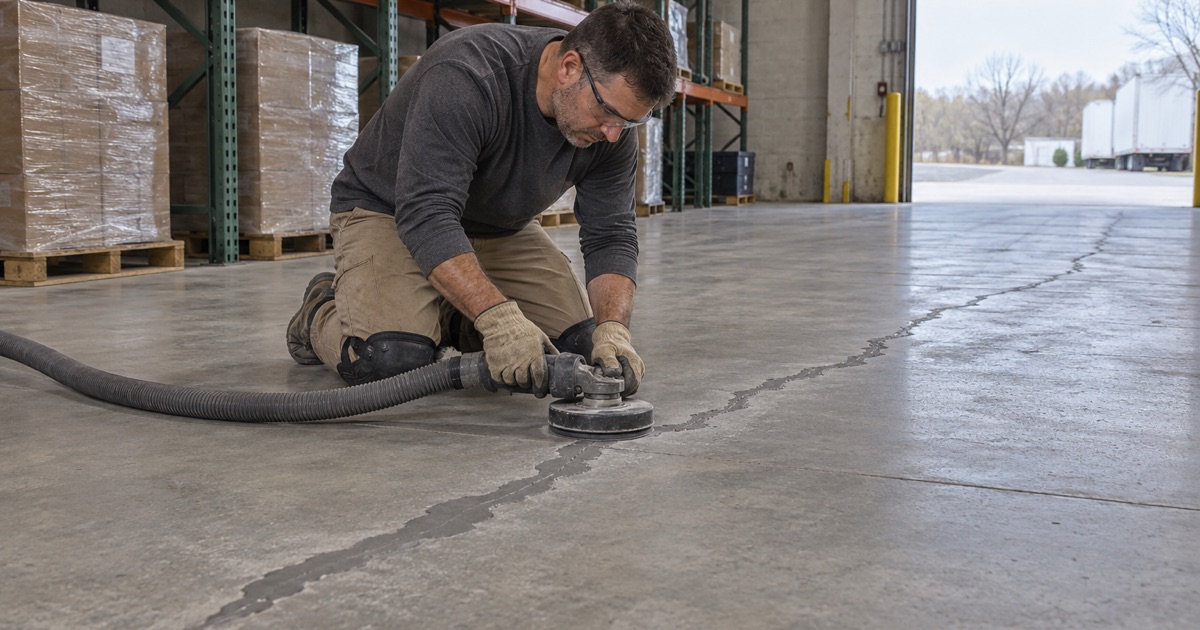
Concrete shrinks as it cures, and most slabs crack somewhere along the way, ideally inside the control joints cut for that purpose. Hairline cracks that wander across a slab between joints are usually shrinkage too and are rarely a structural concern. We rout them open to a clean, consistent profile, vacuum out the dust, and fill them with a repair material chosen for the coating that will follow.
Wider cracks, or cracks with one side higher than the other, point to movement in the slab or the base below it. Those get a closer look, because a rigid filler in a crack that is still moving will simply break loose again. Where movement is expected, a semirigid or flexible filler is the better choice, and we tell you that a hairline may return.
Cracks That Carry Water
In a basement, a crack that darkens after rain or leaves white efflorescence along its length is carrying moisture from below. Filling it from the top does not stop the water, and a coating laid over it will eventually blister along the line. We test the slab, look at the drainage around the foundation, and point you to the right trade first if water is coming through under pressure.
Once the water source is handled, the crack can be repaired and the floor coated, with a moisture-mitigation primer under the system where the readings call for one. We retest after the drainage work rather than assuming it solved the problem.
Spalls, Scaling and Salt Damage
Salt Scaling at the Garage Door
The flaking, pitted concrete common at the front of Waukesha garages is usually salt scaling. Rock salt and calcium chloride brine drip off cars all winter, soak into the surface, and break the top layer apart as they freeze and thaw. The damage tends to be worst at the door and along the tire paths, where meltwater collects longest.
We grind away the weak, scaling surface until we reach sound concrete, then rebuild it with a polymer-modified repair mortar feathered to the surrounding slab. A coating over the repaired area keeps the next winter’s brine on top of the floor, where it can be rinsed off, instead of letting it start the cycle again.
Spalled Edges and Popouts
Spalls are chunks of concrete that have broken away, often at joint edges, along the garage door threshold, or where a heavy object was dropped. Popouts are small cone-shaped holes left when a weak piece of aggregate near the surface expands and breaks free. Both leave sharp edges that grow under traffic and give a coating nothing solid to bond to.
We saw or grind the damaged area back to sound concrete, clean it thoroughly, and fill it with a repair mortar or epoxy patch suited to the depth. The repaired surface is then ground flush so the coating goes on evenly across patch and slab alike.
Joints, Edges and Commercial Floors
Joint Repair Under Forklift and Cart Traffic
In plants, shops and warehouses, the joints are where floors fail first. Hard wheels hitting an open joint chip the edges a little at a time until the joint becomes a wide, broken trench. We clean out the old filler and loose concrete, rebuild the broken edges, and fill the joint with a semirigid filler that supports the edges so wheels roll across rather than slam into them.
That filler is the right choice under a coating as well. A coating bridged over an open joint cracks along it within months, while a supported, filled joint gives the coating a continuous surface to bond to.
Scheduling Repairs Around a Working Building
Commercial repairs often have to happen during short shutdowns, at night or over a weekend. We use fast-setting repair materials where the window is tight and sequence the work so each area returns to service on time. The schedule and the materials are confirmed in writing before the first saw cut.
Repair or Replace
When a Slab Is Past Repair
Some floors are past the point where repair makes sense: slabs that have heaved or settled badly, concrete broken into loose pieces, or floors with widespread deterioration across most of their surface. Patching those buys a season at best. We say so before quoting a coating, because putting a new floor over a failing slab wastes your money.
Replacing a slab is also a different question for the building department than repairing one, so we ask the inspector whether a permit is needed before work of that scope is scheduled. Grinding dust and repair slurry from every job are collected and hauled away, never washed into a floor drain or storm sewer.
- 20+ Years Coating Concrete
- Moisture Testing in Every Scope
- Written Contract Before Any Deposit