
Waukesha Epoxy Flooring installs ESD flooring in Waukesha, WI, serving surrounding cities including Pewaukee, New Berlin, Brookfield, Hartland and Delafield. Static-dissipative and conductive resin floors are a small, specialized part of our work, built for electronics assembly, repair benches, labs, data and server rooms, and any space where a static discharge can damage components or ignite sensitive materials. In more than 20 years of coating concrete, we have learned that an ESD floor is judged by a meter, not by how it looks, so we build to the facility’s own specification and test the finished floor before handing it over.
An ESD floor starts like every floor we install: the slab is ground open mechanically, moisture is tested as a written line item, and cracks and joints are repaired before anything is applied. What makes the system different is what goes in next, the conductive primer, grounding strips and conductive finish layers that give static a controlled path to ground. Each of those is named in the proposal along with the target resistance range.
We plan these jobs around production, since electronics and lab spaces rarely close for long, and we coordinate with your quality or facilities staff on grounding points and acceptance testing before the first grinder starts.
How ESD Floors Control Static
Conductive and Static-Dissipative Ranges
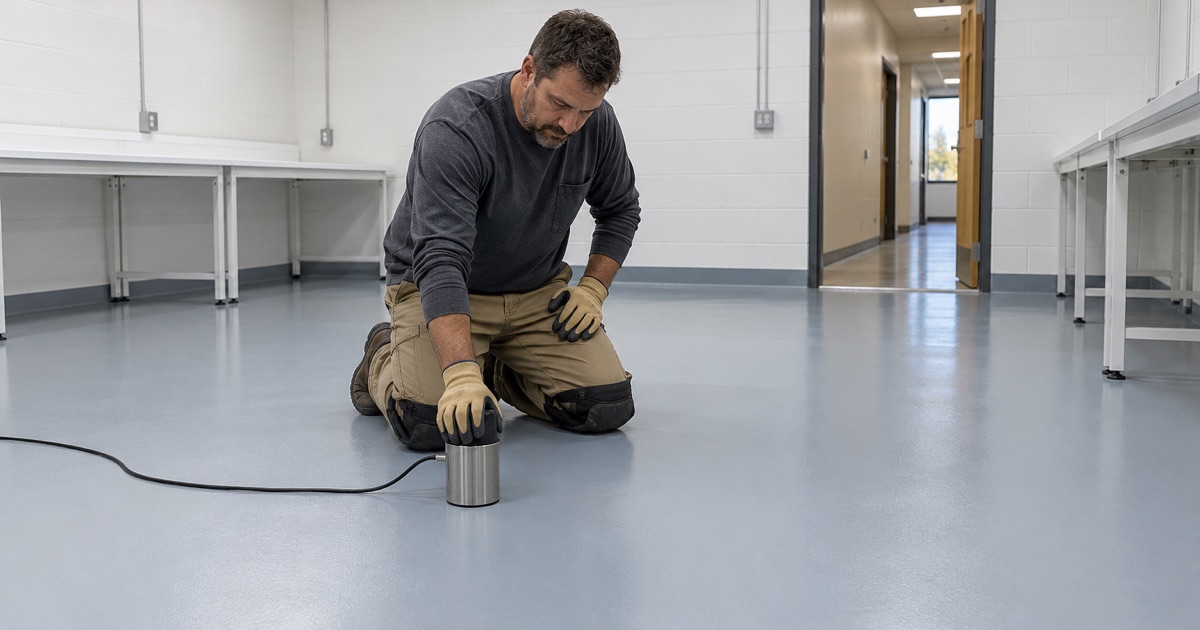
ESD floors are classified by electrical resistance. Under the ANSI/ESD STM7.1 test method, conductive floors measure at or below 1.0 x 10^6 ohms, and static-dissipative floors fall between 1.0 x 10^6 and 1.0 x 10^9 ohms. Conductive floors move charge quickly and suit some explosives and high-sensitivity areas, while dissipative floors are common in general electronics assembly.
Most contractor sites blur those classes together, but your specification will not. We confirm which range the room needs before choosing a product, and the proposal states the range the finished floor is expected to meet.
The Floor as Part of a System
ANSI/ESD S20.20 treats the floor, the footwear and the person as one system. It sets a requirement that resistance through a person wearing ESD footwear standing on the floor stays under 1.0 x 10^9 ohms, and a body voltage requirement of under 100 volts as the person walks. A floor that tests well alone can still fail the system test with the wrong shoes.
That is why we ask what footwear, heel grounders or shoe covers your staff use before recommending a floor, and why acceptance testing is done with your program in mind.
Building an ESD Resin Floor
Surface Prep and Moisture
We grind or shot blast the slab to the profile the ESD system calls for, removing old coatings, waxes and contamination that could interfere with bond or conductivity. Moisture testing comes first, because a moisture problem that lifts any coating will also break the conductive path that makes the floor work.
Cracks and joints are filled before the conductive layers go down, since a gap in the slab becomes a gap in the finish. Where an old ESD floor or a static-control vinyl tile is being replaced, every trace of the previous system and its adhesive is removed so the new grounding layout is not working against leftover materials.
Grounding Strips and Conductive Primer
Copper grounding strips are laid on the prepared slab and connected to verified building ground points at intervals set by the manufacturer. A conductive primer goes down over them, tying the whole floor into a continuous path to ground. Skipping or spacing these too far apart is a common reason ESD floors fail their first test.
We confirm the ground points with your electrician or facilities staff before the strips go down, because a floor wired to a ground that turns out not to be one will test erratically no matter how well the coating was applied.
Conductive Finish Layers
The finish is a static-dissipative or conductive epoxy or urethane, often with carbon or other conductive fillers distributed through it. It has to be applied at a controlled thickness, since a film that is too thick or uneven can push resistance out of range in spots. We check readings as the work proceeds rather than waiting for the final test to find a problem.
Where ESD Floors Are Used
The most common rooms we see are electronics assembly and rework areas, circuit board handling, instrument and calibration labs, server and telecom rooms, and storage areas for sensitive components. Some manufacturing lines need ESD protection only at specific workstations, and in those cases we can build an ESD zone within a larger standard coated floor, with a visible color change so staff know where the protected area begins.
Testing, Maintenance and Scheduling
Acceptance Testing Before Handover
Once the floor has cured, we test resistance across the room at points agreed with your staff, recording readings against the specified range. Results are handed over with the job records, so your quality program has a baseline for future checks. Any area outside the range is addressed before the room goes back into service.
Keeping the Floor in Spec
ESD floors stay in range only when they are cleaned the right way. Waxes, polishes and many general cleaners leave insulating films that raise resistance, so we provide the manufacturer’s cleaning guidance and recommend periodic testing with a resistance meter. Heavy wear lanes can be recoated with a compatible ESD topcoat when testing shows they are drifting.
Working Around Production
Electronics and lab spaces often run on tight schedules, so we phase the work, run grinding off-shift, and use systems that return the floor to service quickly. Grinding dust is captured by vacuum at the source, closed off from clean areas, and hauled away rather than washed into a floor drain, keeping the job within the Waukesha sewer use limits on solids. The schedule is confirmed in writing before work starts.
- 20+ Years Coating Concrete
- Moisture Testing in Every Scope
- Written Contract Before Any Deposit