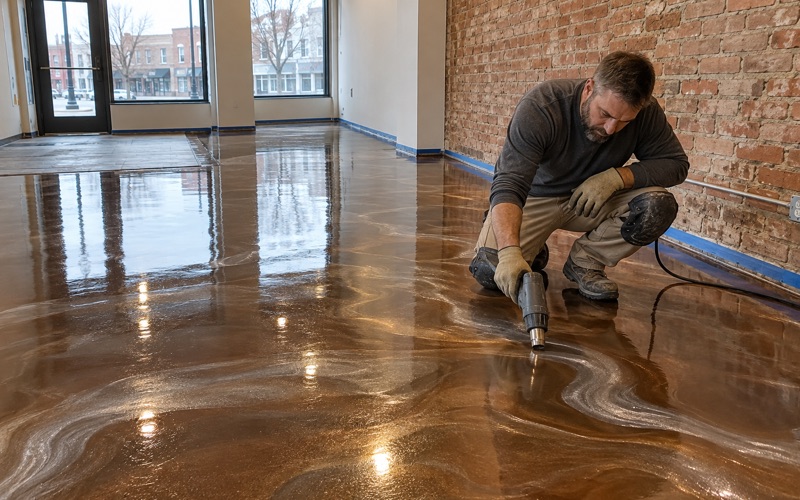
Waukesha Epoxy Flooring has spent more than 20 years on epoxy-flooring in Hales Corners and the surrounding area, and the shop floors we get asked about most here are the ones that sit under a spray gun. A floor in a refinish area takes overspray, solvent drips, sanding dust and primer every working day. What decides whether it lasts is how cleanly all of that comes back off.
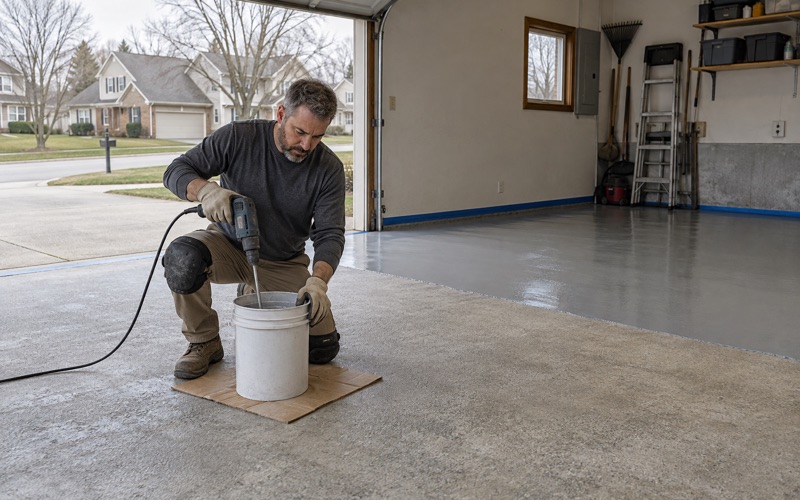
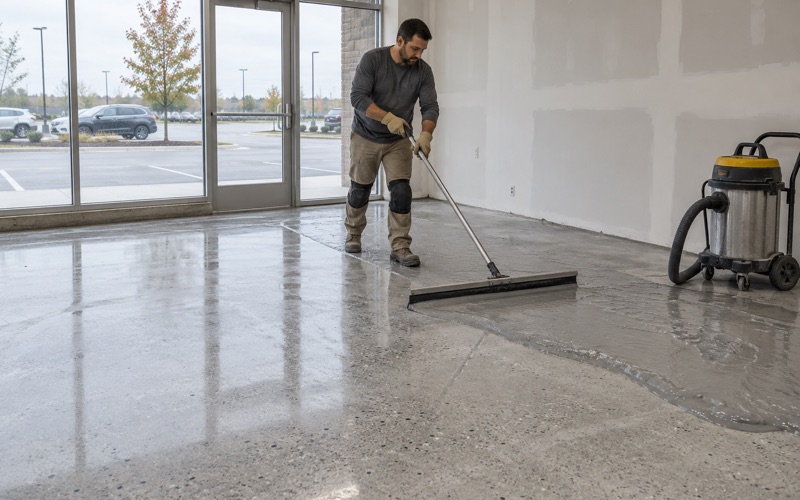
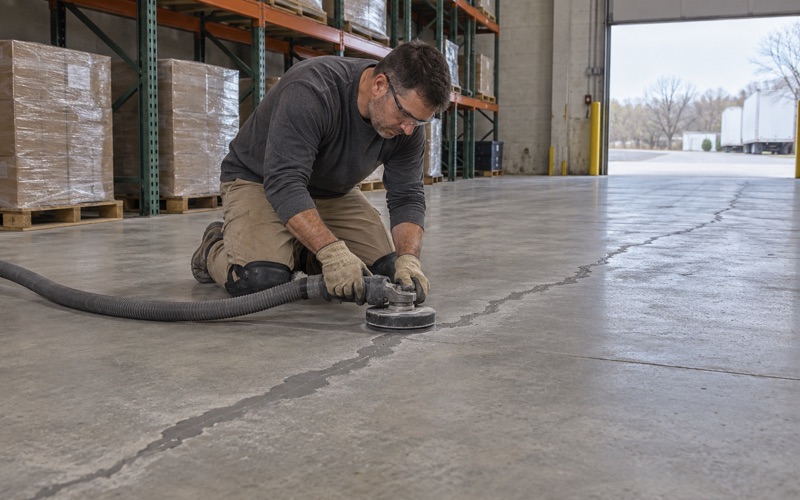
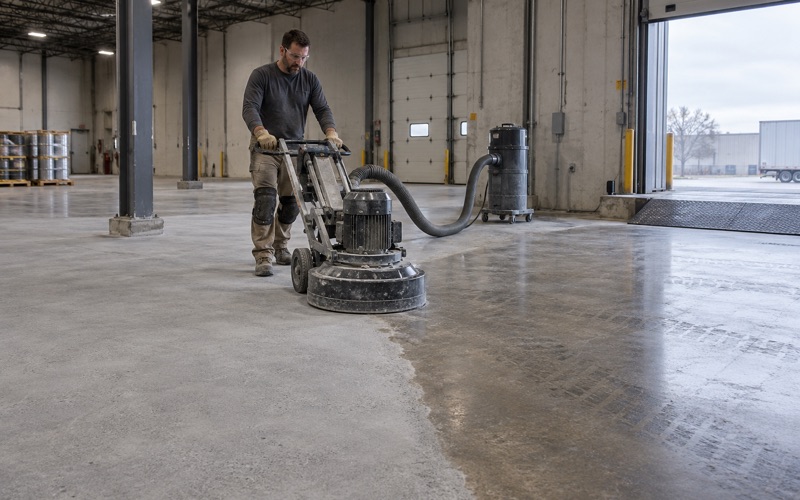
We open every slab with a diamond grinder or a shot blaster before any coating goes down, and we never acid etch. That gives a measured surface profile for the primer to grip, which matters most on a floor where a scraper will be dragged across the same spot hundreds of times a year.
Our written proposal names the product, the system build and the finished thickness for each area of the shop. A body shop owner can hold what was quoted against what went down, and anyone auditing the shop later can see exactly what the floor is made of.
A collision shop on S. 108th Street, and the rule that reaches its floor
Paint work inside the village
Gerber Collision at 6135 S. 108th Street sits inside the Village of Hales Corners and handles collision repair, frame straightening, dents, bumpers and fenders. Its location page lists a computerized color-matching paint system, so refinishing is part of the work done at that address rather than something sent out.
That makes S. 108th Street a fair example of what a shop floor in Hales Corners has to handle. Piller’s Auto Repair on W. Janesville Road and Hale Park Auto on W. Forest Home Avenue keep their own service bays in the village too. Wherever a shop sprays finish, the floor around that work answers to a federal standard, not only to the owner’s preferences.
What 29 CFR 1910.107 actually says
OSHA’s spray-finishing standard, 29 CFR 1910.107, covers spraying with flammable and combustible materials. It defines a spraying area as any area where dangerous quantities of flammable vapors or mists, or combustible residues, dusts or deposits, are present because of spraying. Paragraph (g)(1) says spraying is done only in predetermined spraying areas, which tells a shop owner where the strictest floor demands begin.
Paragraph (b)(3) speaks to the floor directly. If the floor surface of a spray booth and the operator’s working area is combustible, it is to be covered with noncombustible material of a character that makes the safe cleaning and removal of residues easier. A concrete slab is not a combustible floor, but the second half of that sentence describes exactly what any coating laid over one should do.
What we will and will not claim
We never describe a coating as noncombustible, fire-rated or approved by OSHA. Those are product-test questions, and the answer lives in a manufacturer’s test data, not in a contractor’s sales pitch. What we can tell a shop is how a given system holds up to the cleaning the standard expects, and we put that product’s name in writing so the data can be checked.
Looking for epoxy-flooring closer to West Allis? See West Allis Epoxy-Flooring.
Overspray every day: scrapers, spuds and nonsparking tools
Daily cleaning is written into the rule
Paragraph (g)(2) asks that all spraying areas be kept as free from accumulated combustible residue as practical, with cleaning done daily if necessary. Scrapers, spuds and other cleaning tools are to be made of nonsparking material. Paragraph (g)(3) adds that residue scrapings are removed immediately rather than left in a pile against the wall.
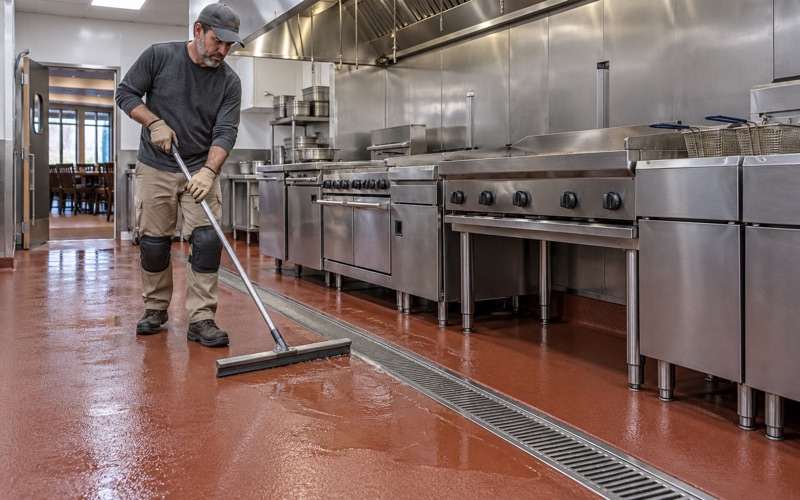
For a floor, that is a plain description of its working life. Someone in the shop will take a brass or composite scraper to it at the end of a shift, push dried overspray into a heap and carry it out. A coating chosen for a showroom look instead of for that routine tends to show the mismatch within its first season.
What a nonsparking scraper asks of a surface
Nonsparking tools are softer than hardened steel, so they depend on the residue letting go rather than on cutting through it. A hard, smooth, well-bonded surface lets the blade slide under a dried film and lift it. A soft or poorly bonded surface lets the blade catch at an edge and peel the coating back along with the paint.
That is why we judge a paint-area floor by how it takes a scraper, not by its gloss on day one. A topcoat with good hardness and chemical resistance, over a primer that went into a properly profiled slab, lets the daily cleaning in (g)(2) happen without the floor coming up in strips or flakes.
Texture is a trade-off here
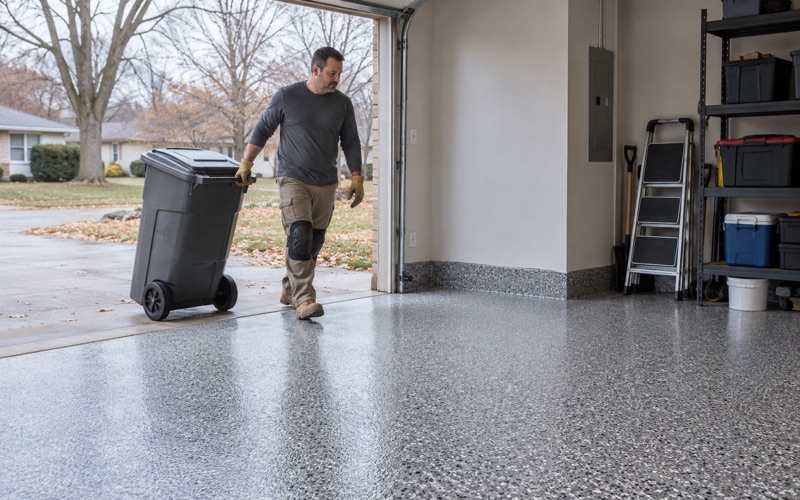
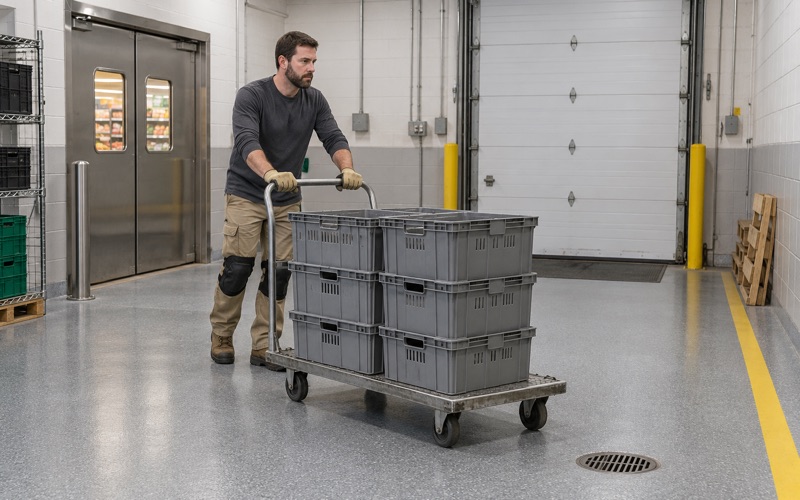
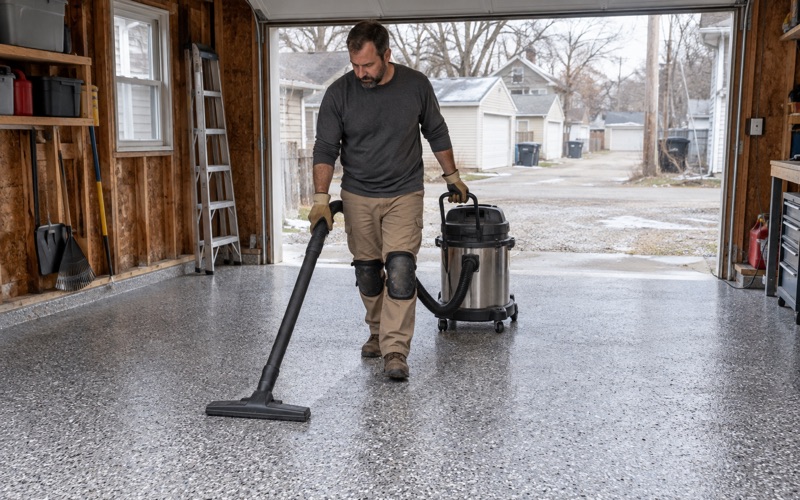
Broadcast systems with vinyl flake or quartz aggregate add grip, and in a wet wash bay that grip earns its place. Under a spray gun, a deep texture also gives overspray thousands of small edges to cling to, and a scraper rides over the peaks without reaching the valleys. In paint areas we usually look at a fine texture or a smooth topcoat, and we talk through where slip risk sits in the room before settling on one.
A floor that gives residue up without tearing
Bond comes first
Peeling on a shop floor usually starts at the bond line, not at the surface. We grind to an ICRI CSP profile matched to the system and read every crack, joint and patch of old coating before quoting. When a slab needs repair or replacement before it can be coated, the proposal says so plainly instead of hiding the problem under a fresh layer.
Old coatings deserve the same scrutiny. A shop floor that was painted or sealed years ago may carry layers of different products, some soaked with solvent and some already lifting. We grind those layers off rather than coat over them, because a new system is only as well bonded as whatever sits directly underneath it.
Grinding dust and slurry are collected on site as we work. Nothing from our prep goes into a floor drain or a storm sewer, which in a shop already managing paint waste and solvent leaves the owner with one less discharge question to answer.
Moisture before money
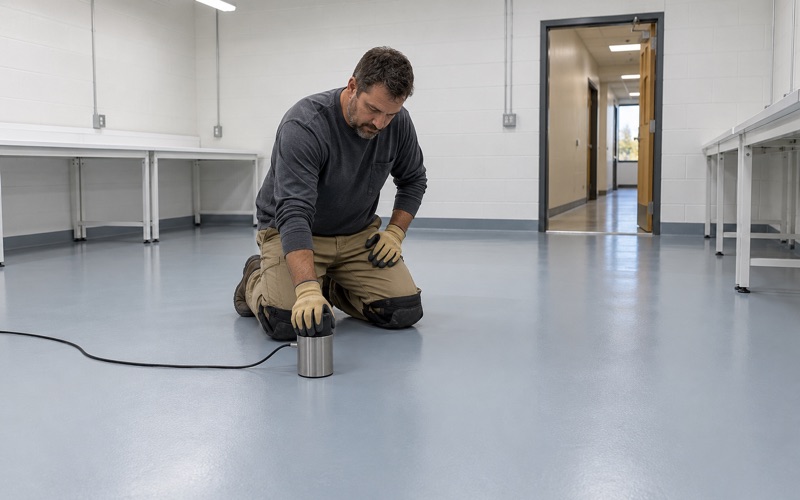
Moisture testing is a line item in our scope, not an upsell after a failure. Depending on the slab we use ASTM F1869 calcium chloride tests, ASTM F2170 in-situ relative humidity probes, or the ASTM D4263 plastic sheet test as a first read. Moisture moving up through concrete is a common reason coatings blister and let go, and it is the first exclusion we read out before any warranty is sold.
Where readings run high, a moisture-mitigation primer can go down beneath the build. Where a slab shows active water or hydrostatic pressure, we do not sell a coating as the cure for it, and we say so before anyone signs.
Picking the system for solvent and overspray
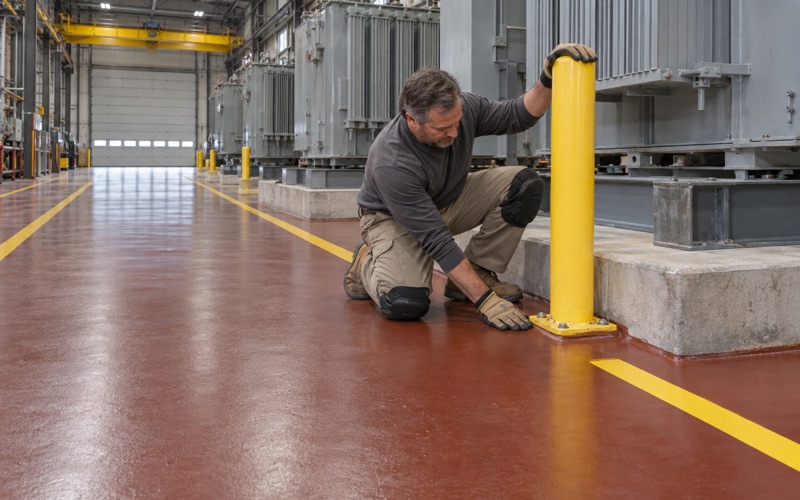
Paint areas see reducers, cleaners and thinners that some floor systems tolerate better than others. A 100% solids epoxy base with a polyaspartic or polyurea topcoat is a common build, and urethane cement is another option where heat and heavy chemical exposure are expected. No coating is immune to every solvent, so we review each product’s chemical resistance chart against what the shop actually sprays and wipes with.
We also watch for amine blush between epoxy layers and for outgassing and pinholes coming up from the slab during application. Both leave a surface that holds residue instead of shedding it, and both are far cheaper to prevent on the day than to grind out afterward.
Color is a practical choice in a paint area, not only a looks question. A light, even topcoat shows overspray and drips as they land, so the crew sees what needs scraping before it builds into a crust. A dark or heavily patterned floor hides residue until it is thick enough to catch a scraper blade or a creeper wheel.
Prep, mixing and rag cans: the rest of the paint area
Beyond the spraying area
Overspray and drips do not stop at the edge of the spraying area. Prep stations, the mixing room and the path between them see primer, sealer, sanding dust and the occasional spilled can. We usually carry the same system, or a close relative of it, across those floors so the cleaning routine stays the same from the mixing bench to the bay door.
Body and frame areas carry a different load: grinding sparks, dropped parts and creepers rolling across joints. We fill shop joints with a semirigid filler before coating so carts and wheels do not break the edges, and we study the joint layout before deciding where one coating system should end and another begin.
Rag cans and the end-of-day routine
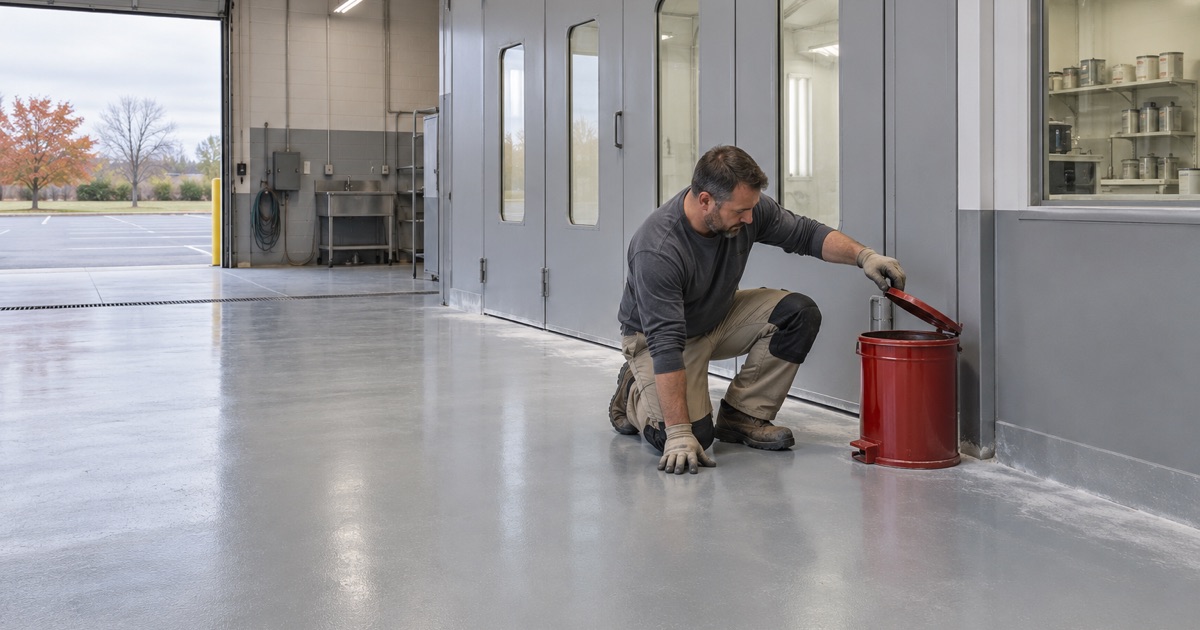
Under (g)(3), finish-soaked rags go into approved metal waste cans that are emptied at least daily. That can sits on the floor, gets nudged every time someone uses it, and now and then weeps a little. A coated floor that wipes clean around it keeps residue from building up in one corner where nobody looks until it is thick.
Scheduling around a working shop
Body shops rarely close for a week. We plan floor work around the hours a building has to keep running, including overnight and weekend windows, and we split a shop into zones so one bay can keep working while another cures. Cure timing follows slab temperature and the dew point spread at the slab surface, not the calendar.
A floor that feels hard underfoot is not always ready for solvent. Most systems reach walk-on hardness well before they reach full chemical resistance, and spraying or wiping thinner over a coat that is still curing can soften or mark it. We give the shop a written return-to-service date for light traffic and a later one for full paint work, and we explain why the two differ.
Permits and products in Hales Corners
Milwaukee County lies entirely within the 2015 ozone nonattainment area, and Wisconsin has no architectural-coating VOC rule of its own, so the national 40 CFR 59 Subpart D limits govern the products we bring in. Before a job is scheduled, we ask Village of Hales Corners Building Inspection whether it needs a permit, because coating an existing slab and adding a drain or replacing concrete are different questions.
If your shop sprays finish and the floor no longer gives residue up cleanly, we start with a site visit: moisture readings, a look at the bond and the joints, and a talk about what your crew cleans with each night. The proposal that follows names the product, the build and the thickness, and it says plainly what the floor can and cannot do.
- 20+ Years Coating Concrete
- Moisture Testing in Every Scope
- Written Contract Before Any Deposit