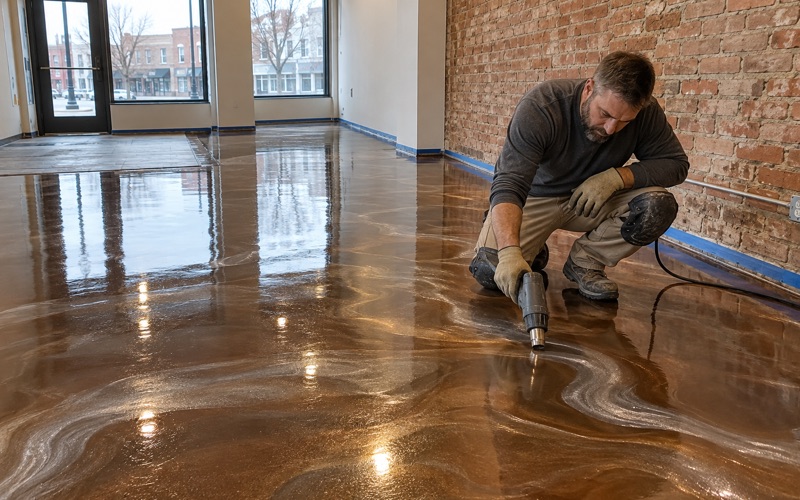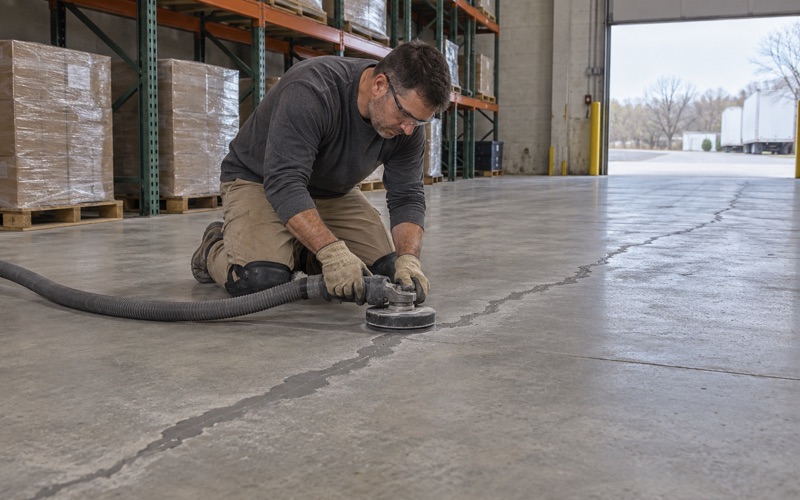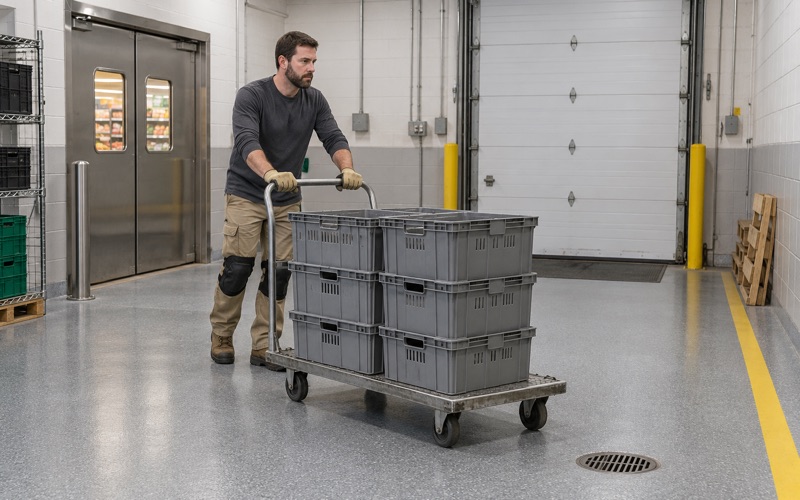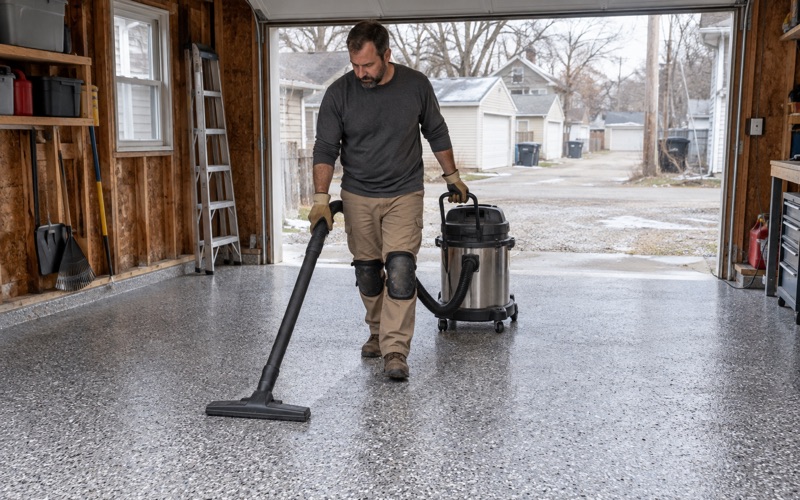
Waukesha Epoxy Flooring has spent more than 20 years installing epoxy flooring in Menomonee Falls and across the county, and the jobs we are asked to quote here split two ways: industrial floors that have to stand up to oil and coolant, and home garages that have to stand up to winter. Both start the same way, with a slab we have looked at closely before we put a number on it.
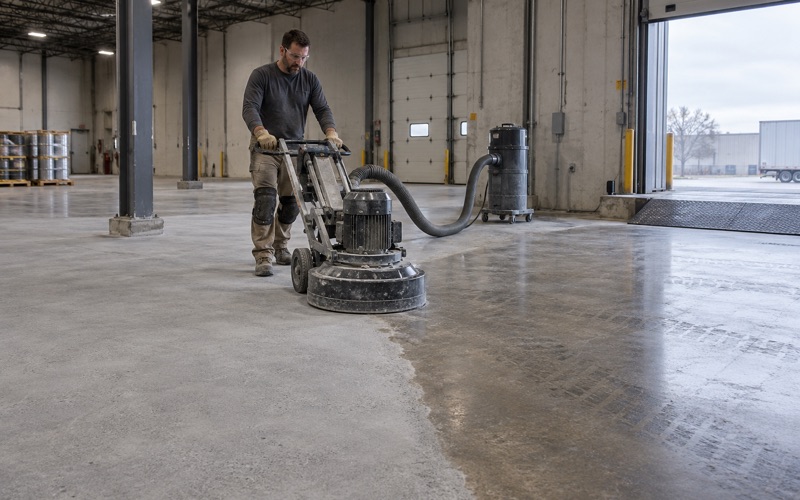
We open every floor mechanically with a diamond grinder or a shot blaster, and we never acid etch. Before we quote, we read the cracks, the joints and any coating already down, and if a slab needs repair or replacement before it can carry a coating, we say so in writing rather than coating over the problem.
Our proposals name the product, the system build and the finished thickness. That gives a plant manager or a homeowner something concrete to hold the finished floor against, and it keeps the conversation about what the floor has to survive instead of what it will look like on the day we leave.
Epoxy for Menomonee Falls Shops and Homes
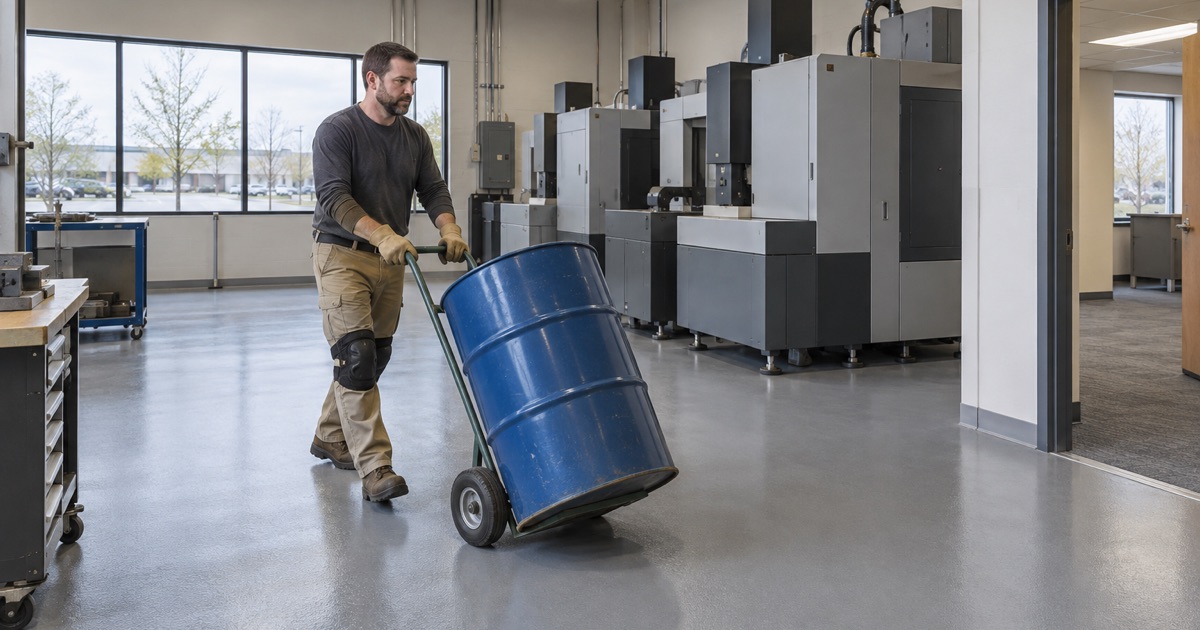
The village carries a mix that shapes our schedule here. There is working industrial space that the village is actively trying to add to, and around it sit neighborhoods of owner-occupied houses with attached and detached garages. A single week can include a production floor that has to come back into service on Monday and a two-car garage that cannot be coated until the slab is warm enough.
Plant and shop floors
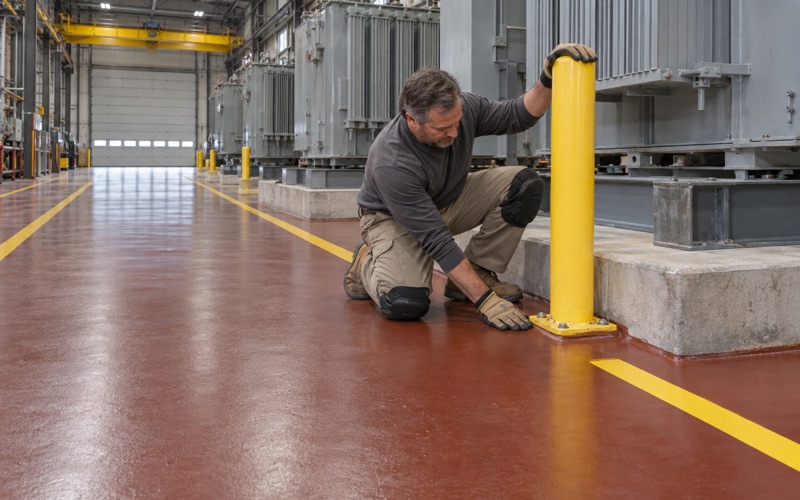
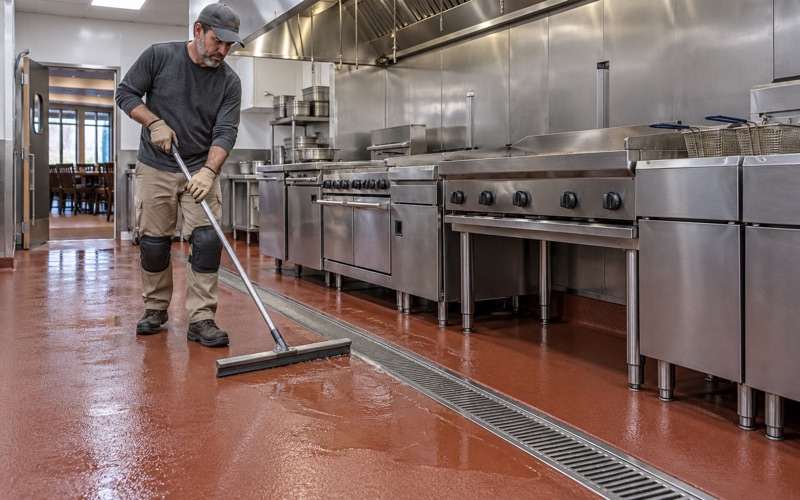
Industrial work in the village is usually about chemistry and traffic rather than color. We look at what spills, what drips, what rolls across the floor and how often, and then we build the system from the primer up. A shop that runs oil and coolant all day needs a different build than a warehouse that only sees pallet jacks.
Joints get attention before any coating goes down. We fill plant, shop and warehouse joints with a semirigid filler so forklift and cart wheels ride across them without chipping the edges. A coating bridged over an open joint is the first thing to fail under steel wheels, and it fails in a straight line right where the traffic is heaviest.
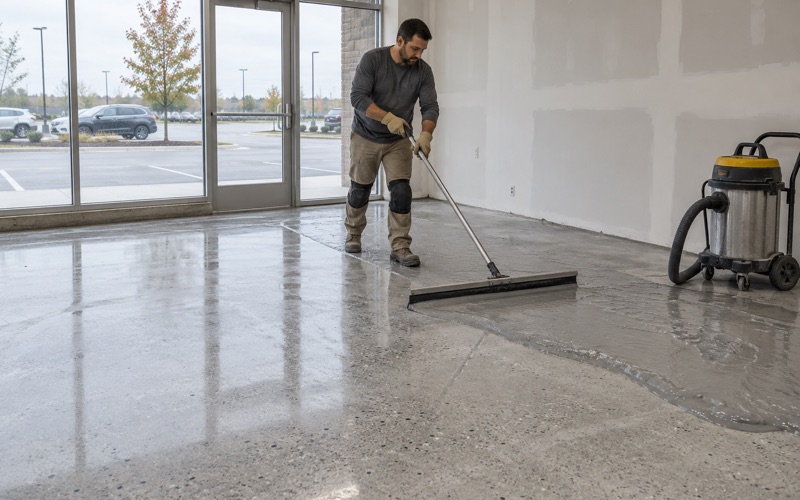
We also work around the hours a building has to keep running. Overnight and weekend windows are normal for us, and we plan the grinding, the coats and the cure so that a line can restart on schedule. If the cure time a system needs does not fit the window, we tell you before the job, not after.
Home garages
On the residential side, most of what we coat in the village is a garage under an owner-occupied house. We build those floors for the road salt and calcium chloride brine that come in on tires every winter, because that brine sitting in a puddle under a car is what pulls apart a thin roll-on coating by spring.
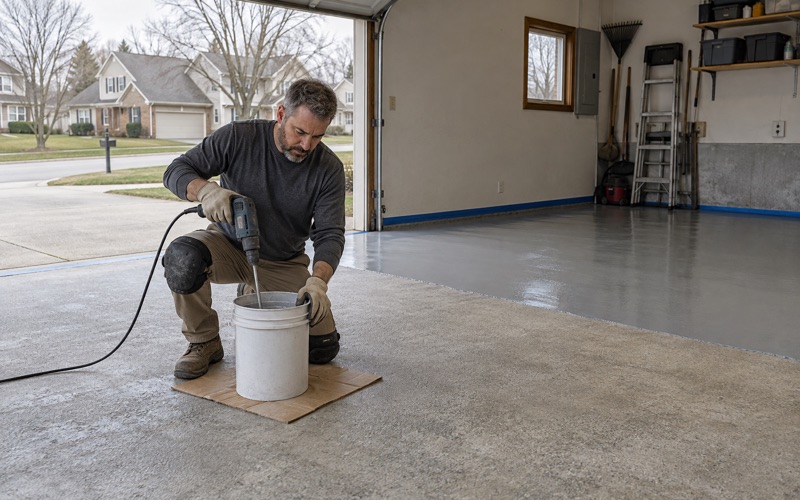
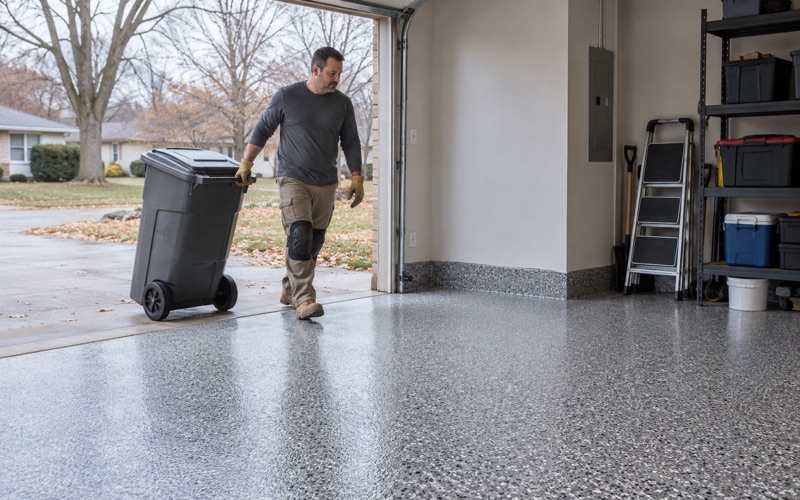
A typical garage system here is a 100% solids epoxy base with a vinyl flake broadcast and a polyaspartic topcoat. The flake hides the grit a garage collects, and the topcoat resists hot tire pickup, the lifting and marking a thin coating suffers when warm tires park on it after a highway drive.
Looking for epoxy-flooring closer to Greenfield? See Epoxy-Flooring Services in Greenfield.
From Office Floor to Mold Shop on Woodale Drive
The clearest example of what is changing in the village sits on Woodale Drive. According to BizTimes, Dynamic Tool, a maker of custom plastic injection molds, bought the 110,000-square-foot building at N54 W13600 Woodale Drive in 2022 for $4.3 million. The building went up in 1989 and served as the former Kohl’s customer service and operations center.
The company’s stated plan is to renovate that building for manufacturing, engineering and development and to build roughly 50,000 square feet more on the rear of the property. The village proposed a $4.45 million tax incremental district covering 21.6 acres to support the project, and village documents described new industrial space as harder and harder to find.
Why that matters for a floor
A slab that spent three decades under office desks, cubicles and carpet has lived an easy life. It has never been asked to hold up under a machine tool, it has never been soaked in cutting fluid, and it has never had oil tracked across it by the shift. Nothing about how it performed as an office floor tells you how it will perform as a shop floor.
That is the conversion problem in one sentence: the floor is being chosen for a use it has never seen. When we look at a building like this, we are not asking whether the concrete looks sound. We are asking whether the system on top of it can stand up to the fluids the new tenant will put on it every day.
The broader pattern
The Woodale building is one example of a larger trend. When new industrial space is scarce, older office and flex buildings get pulled into manufacturing use, and each of those floors arrives with the same gap between what it was built for and what it is about to carry.
For an owner planning that kind of move, the floor belongs in the conversation early. Grinding a large open office slab, filling its joints and building an oil-resistant system takes time, and it goes faster before the machines are set than after they are bolted down.
Coolant, Dielectric Oil and the Floor System
Mold making as a trade runs on precision machining and on sinker EDM. Machining brings water-based coolant and way oil to the floor. Sinker EDM machines work with the part submerged in a dielectric fluid, commonly a hydrocarbon or mineral oil, that insulates the cut, cools the work and flushes debris through a filtered circulation loop.
Where the oil ends up
That dielectric oil does not stay in the tank. It is dragged out on parts and electrodes, it drips during filter changes, and it is carried away on the soles of shoes. Coolant does the same around mills and lathes, and over time a thin film builds up on the floor that a weak coating will absorb, soften under or lift away from.
Suppliers market high-flash-point dielectric grades for fire safety, which is the right concern for the machine, but the floor still sees the oil. We plan for that exposure as a daily condition, not an accident, and we pay particular attention to the ring of floor around each machine where the drag-out lands.
Building for oil it has never seen
For a floor like this we start from a properly profiled slab, taken to the ICRI CSP range the primer calls for by diamond grinding or shot blasting. From there the choice is usually between a high-build 100% solids epoxy and, where heat, chemicals or heavy wash-down are involved, a urethane cement system, which handles thermal shock and aggressive fluids better than epoxy alone.
Quartz aggregate broadcast into the build gives the floor texture where oil makes a smooth surface dangerous. We size that texture to the area: more grip at the machines and wash stations, less in the aisles where carts and pallet jacks need to roll easily and the floor has to be swept clean.
If part of the shop holds electronics or controls, we can discuss a static-dissipative system specified to a stated resistance range. We put that requirement in the proposal by number, along with the product, the build and the thickness, so the owner can check what went down against what was quoted.
Moisture first
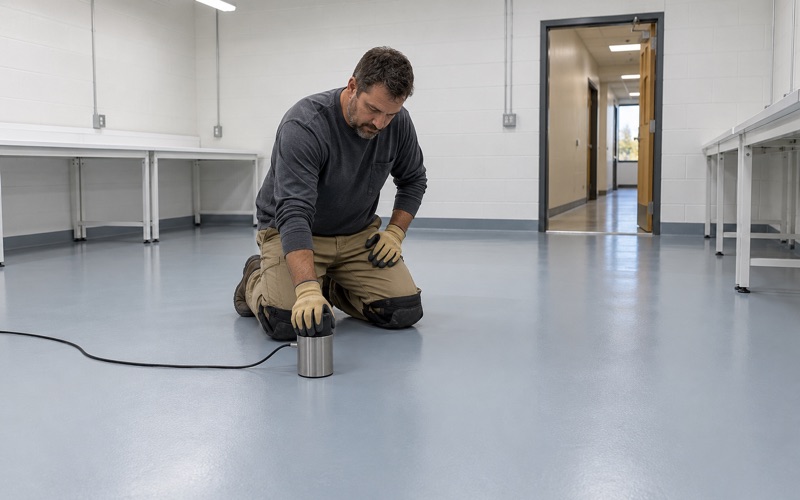
An old office slab can look perfectly dry and still be pushing moisture. Before we coat, we test, using ASTM F2170 in-situ relative humidity probes or ASTM F1869 calcium chloride testing depending on the slab, and we write that testing into the scope as its own line item rather than offering it after a floor blisters.
If the readings come back high, a moisture-mitigation primer goes under the system. We also read the warranty exclusions out loud before the job is sold, with moisture from below named first, because a coating cannot stop water coming up through a slab and we do not sell one as though it could.
Permits, Plan Review and Garage Floors in the Village
On the commercial side, plans in Menomonee Falls do not all go to the same place. The village holds Appointed Agent status from the Wisconsin Department of Safety and Professional Services for building and HVAC plan review, so some non-residential plans are reviewed by the village and others must go to DSPS.
Who reviews what
The Village of Menomonee Falls Building Inspection Division handles permits and building, electrical, HVAC and plumbing inspections for residential and non-residential work. Its building applications line is 262-532-4400. Which reviewer a given conversion goes to depends on the project, so we ask the question before we put a start date on the calendar.
Coating a sound slab and replacing one are different questions, and only the second is clearly construction. We confirm with the village inspector whether a job needs a permit before we schedule it, and on a larger conversion we coordinate with the general contractor so the floor fits into the review that is already underway.
Air quality and coatings
The village sits inside the part of Waukesha County that is in the Milwaukee 2015 ozone nonattainment area, reclassified as Serious in January 2025. Wisconsin has no state architectural coating VOC rule, so the federal 40 CFR 59 Subpart D limits apply, and the 100% solids and low-VOC products we favor fit comfortably within them.
Grinding dust and slurry are collected on site with vacuum equipment. None of it is washed into a floor drain or a storm sewer, which matters in a shop where the drains already carry their own load and the owner answers for what goes into them.
Garage floors under village homes
Housing in Menomonee Falls is mostly owner-occupied single-family homes, with 10,990 owner-occupied detached units out of 12,122 owner-occupied units in the Census estimates. The 1960s built more of the village’s homes than any other decade, so many garage slabs are more than half a century old by the time we see them.
Older garage slabs tell us a lot when we look closely. We read the cracks, check for spalling where salt has worked into the surface, and look for old paint or sealer that has to come off. When a slab is past saving with a coating, we say so plainly instead of selling a floor that will flake.
Wisconsin does not require a vapor retarder under an unconditioned attached garage slab, so a dry-looking garage floor is not proof of a dry one. We test before we coat. We also schedule the cure against slab temperature and dew point rather than the calendar, and when an unheated garage has to wait for spring, we tell you that up front.
Every home job in the village starts with a written contract before any deposit changes hands. The products and any warranty are written into it, so what we promised and what we installed can be checked against the same document long after the floor is in service.
- 20+ Years Coating Concrete
- Moisture Testing in Every Scope
- Written Contract Before Any Deposit