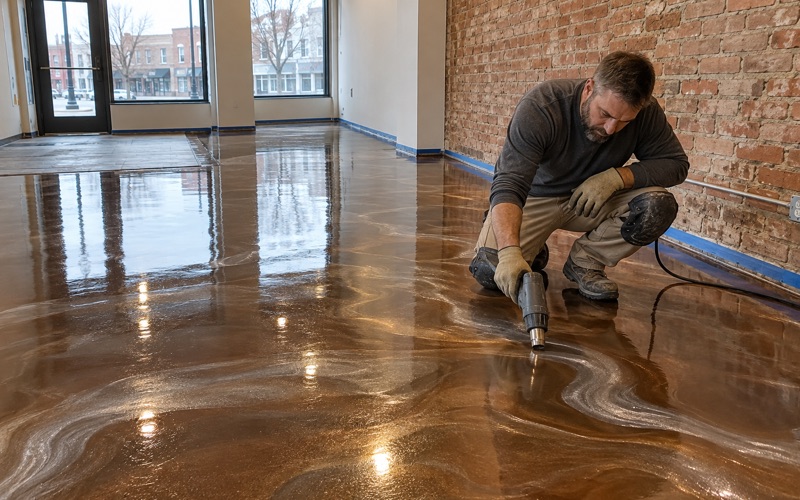
Waukesha Epoxy Flooring has handled epoxy-flooring in Muskego and across the county for more than 20 years, and a good share of the floors we look at here belong to people who make things. Fabrication bays, hobby welding corners in a two-car garage, small shops behind a house: each one asks a floor to stay tight, clean and easy to sweep while sparks and grit land on it every day.
That changes what we put in a proposal. Before anything is quoted we walk the slab, read every crack and control joint, look at whatever coating is already there, and tell you plainly if the concrete needs repair or replacement first. The written scope then names the product, the system build and the finished thickness, so you can check the floor that went down against the one you paid for.
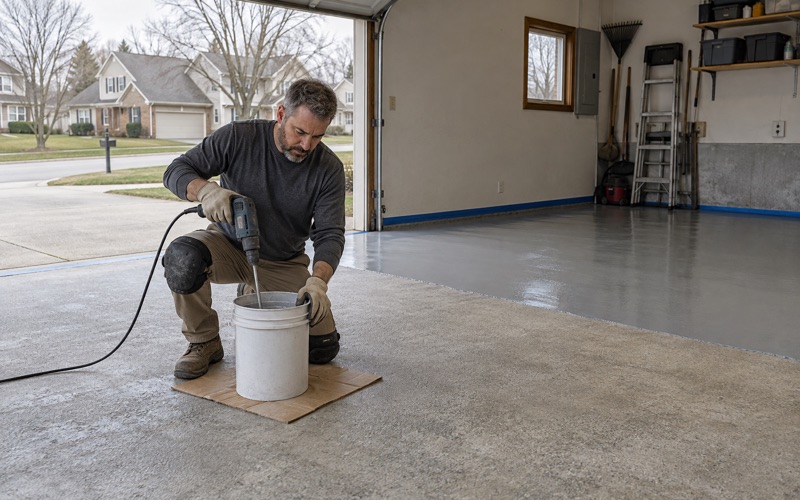
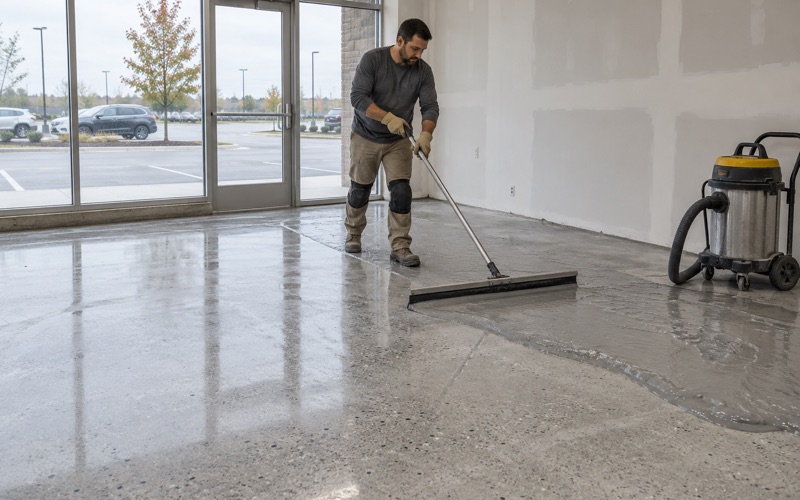
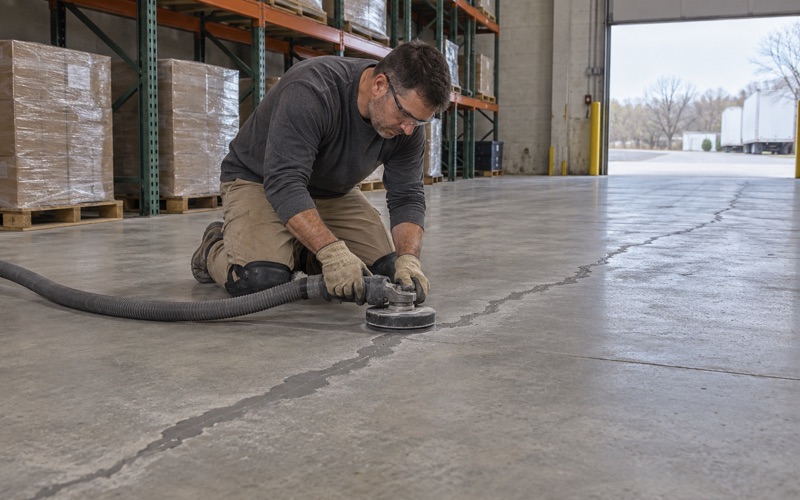
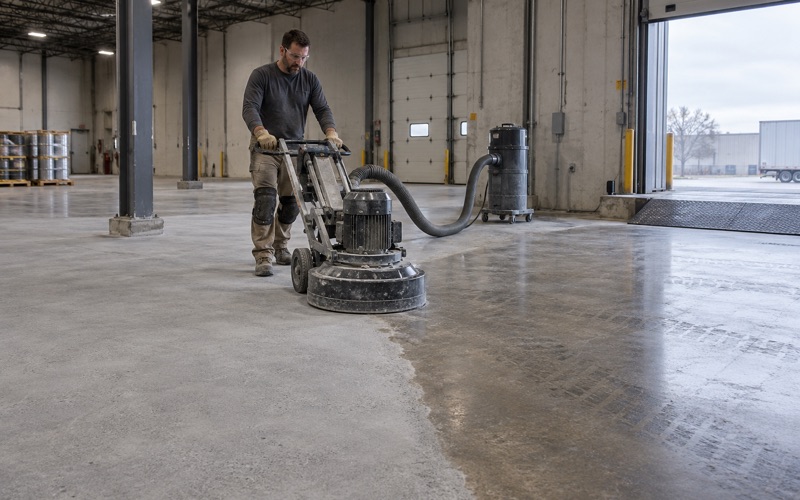
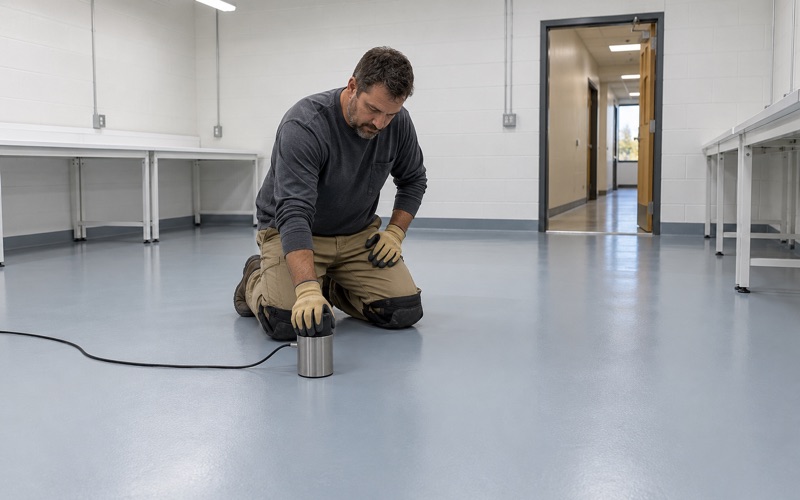
Preparation is never chemical. Every slab is opened with a diamond grinder or a shot blaster to a measured ICRI CSP profile, and we do not acid etch. Moisture testing is listed as its own line item on a garage slab or a shop slab, because a coating that blisters from below is a problem to find before the job, not after it.
A Robotic Welding Cell at Muskego High School
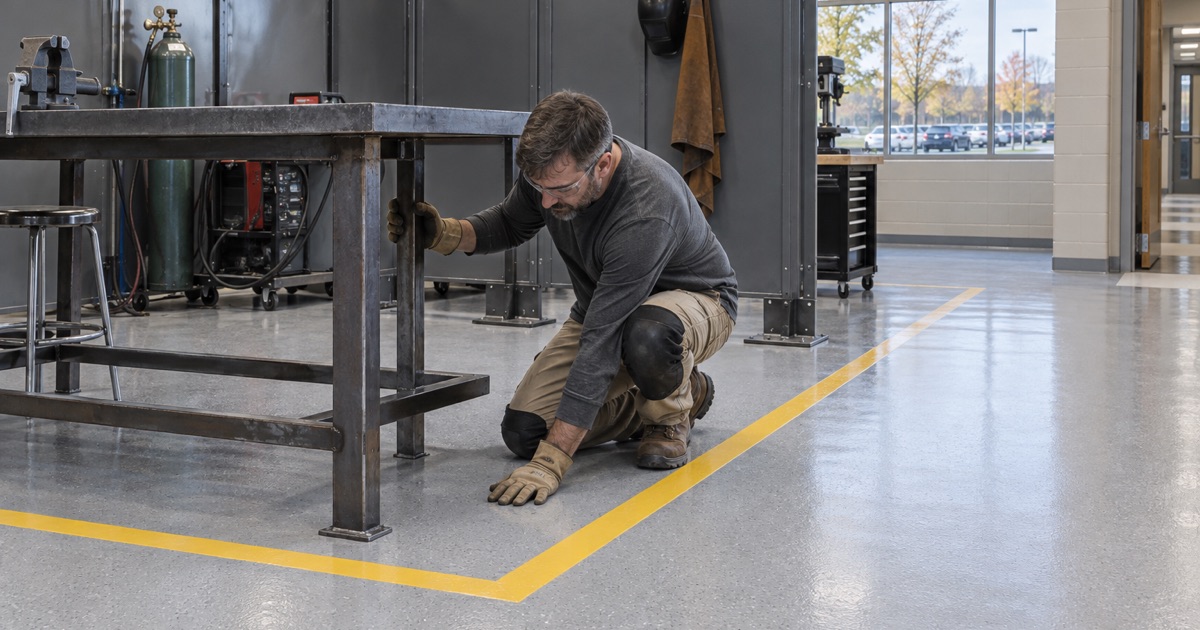
The clearest local picture of what a welding floor has to do sits at the high school on Racine Avenue. In a release dated March 15, 2023, the state Department of Workforce Development announced a $50,000 Wisconsin Fast Forward grant to the Muskego-Norway School District for an ARC welding robot. The stated goal was hands-on robotic welding training and confidence running a range of material handling and ARCMate robots.
The robot arrived alongside a much larger building project. Bray Architects describes a tech ed and STEAM addition with state-of-the-art shops and labs, part of a 95,900 square foot addition paired with an 87,300 square foot renovation. The STEAM and Health Science addition came out of a $44.6 million referendum that district voters approved in 2022.
What the federal welding rule says about the floor
We have not seen that lab, and nothing in the grant describes its floor. The grant names a robot. What the federal rule does describe is the floor around any welding operation, and it is worth reading for anyone planning a weld area. The fire prevention section of 29 CFR 1910.252, paragraph (a)(2), speaks to floors more directly than most people expect.
Two parts of it matter for a concrete slab. One covers combustible material lying on the floor near the work, and the other covers floor openings and cracks that cannot be closed. Neither one names a coating product or grades resin as safe or unsafe, which is why we never describe any floor system as approved under it. The rule describes conditions, and the floor either supports them or works against them.
How the rule reaches a Wisconsin school
Federal OSHA does not cover public employers in Wisconsin directly. Instead, the state’s public-employer safety rule, SPS 332, applies to all workplaces of public employers and brings OSHA general industry standards to them, with some sections amended. In practice that means a school district’s staff work under the same welding fire prevention language a private fabrication shop does, and a weld lab is planned with it in mind.
Looking for epoxy-flooring closer to Wauwatosa? See Epoxy-Flooring Services in Wauwatosa.
Thirty-Five Feet Swept Clean, and Cracks That Let Sparks Through
The line in 1910.252 that people quote most often is the sweep distance. Where combustible materials such as paper clippings, wood shavings or textile fibers are on the floor, the floor has to be swept clean for a radius of 35 feet, or about 10.7 meters, around the welding. That is a large circle in a combined shop where a wood area and a metal area share one room.
Why sweepability is a floor question
A bare, dusted slab fights that requirement every day. Raw concrete sheds fine grit, holds sawdust in its surface pores and leaves shavings packed into spalled joints where a broom skips over them. A sealed floor built at a known thickness gives the broom a continuous surface, so a 35-foot sweep removes material rather than rearranging it.
In a shop that also cuts wood, we usually recommend a 100% solids epoxy body coat with a quartz aggregate broadcast set to a light texture. That gives footing without deep valleys for chips to settle into. A smoother vinyl flake finish under a polyaspartic topcoat suits a cleaner metal room, where the main work is sweeping grinding dust and wiping spatter.
Cracks the rule tells you to close
The same paragraph says that wherever floor openings or cracks cannot be closed, precautions have to be taken so readily combustible material on the floor below is not exposed to sparks dropping through. On a slab on grade there is rarely a floor below, but open cracks and broken joints still collect debris that a broom cannot reach and sparks can settle into.
So crack and joint work is the first line of our scope in any weld area. Active cracks are routed and filled, and control joints are cleaned out and filled with a semirigid filler before any coating crosses them. That keeps cart and lift wheels from chipping the joint edges, and it leaves a continuous floor where nothing collects in the seams.
Wet floors and arc welding
The rule also allows combustible floors to be kept wet, covered with damp sand or protected by fire-resistant shields, and where a floor is wet down, arc welding personnel are to be protected from possible shock. On a concrete shop floor the more common choice is shields and good housekeeping rather than water. We point that out only so a floor plan does not assume a wet-down routine the shop never intends to use.
Spatter, Shields and Shop Floors in a STEAM Addition
Right around a welding cell, no decorative finish is the main defense. Hot spatter lands, cools and sticks, and a grinder dropped on its side will mark almost any surface. The shields, curtains and mats a shop already uses are what take that punishment, and we plan the floor around them rather than pretending the coating replaces them.
Planning the zone right around the cell
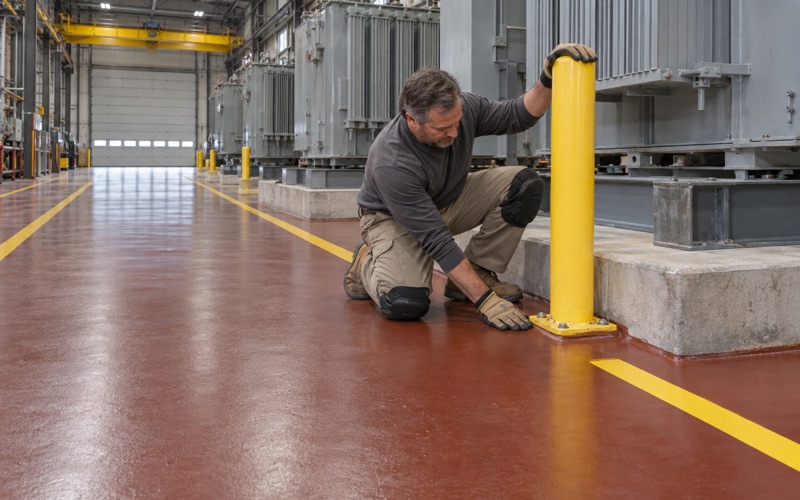
In a fabrication space, we keep the floor under and right beside the cell simple and repairable. A durable, sealed body coat in a plain color shows spatter marks honestly and patches cleanly when a section wears. Brighter flake blends and safety striping go a few feet out, in walkways and staging areas, where the floor earns its appearance instead of collecting burn marks.
We also flag places where a mat or fire-resistant shield will sit permanently. Those spots do not need the same topcoat build as an open aisle, and saying so in the scope keeps the thickness and the price honest. The goal is a crack-free floor with clean joints that sweeps easily all the way to the cell, while the shop’s own shields stand at the cell itself.
Fab lab, wood shop and metal shop on one plan
The Daily Reporter noted in April 2024 that a $24,700 WEDC grant would equip a new fab lab at the high school, then under construction. A building like that mixes rooms with different jobs: a fab lab with laser and CNC equipment, a wood shop that throws chips, a metal shop that throws sparks. Each wants a slightly different floor.
When we scope a commercial shop with that mix, we give each room its own line. A metal room may get a heavier body coat and a matte finish, and a wood room more texture and a topcoat that resists scuffing from benches. A clean electronics bench area might need a static-dissipative system built to a stated resistance range, which we only quote when the equipment calls for it.
Scheduling around a working building
Shops in schools and plants rarely close for a week. We schedule commercial floors around the hours a building must keep running, including overnight and weekend windows, and phase rooms so one shop is down while its neighbor works. Grinding dust and slurry are collected on site, never washed into a floor drain or out to a storm sewer.
Welding on a Muskego Garage Floor
The same logic scales down to a home shop, and Muskego has plenty of places for one. Census figures show 8,703 owner-occupied homes out of 10,267 occupied units, with most housing in detached single-family homes. Many of those garages hold a MIG welder, a plasma cutter or a grinder bench alongside the cars.
A hobby welding corner beside the cars
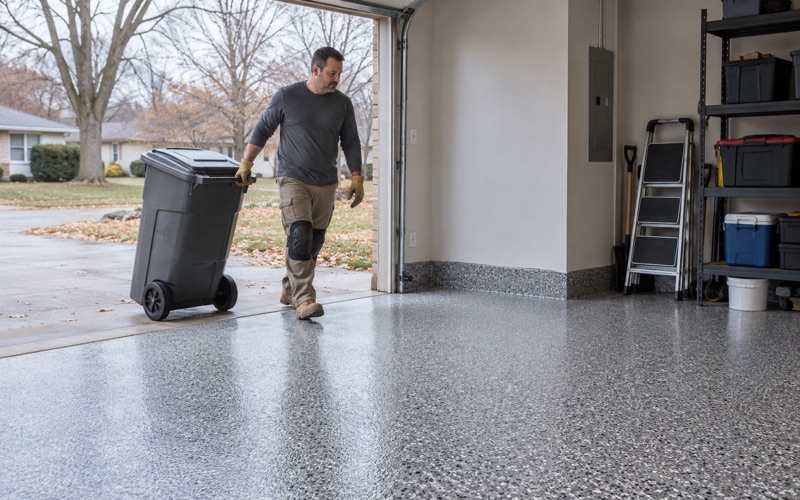
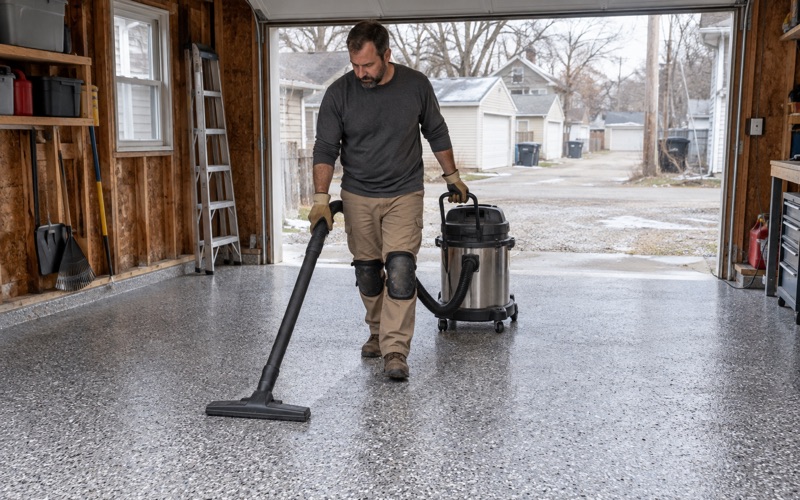
A garage that doubles as a weld shop asks two things of the floor. It has to survive winter, when tires track in road salt and calcium chloride brine, and it has to sweep clean where sparks and grinding dust land. We build Muskego garage floors for the salt first, then pick a texture and topcoat that a push broom and a shop vac can actually clear.
When a garage holds a welding cart, we suggest keeping a fire-resistant mat or shield where the work happens and a clear swept zone around it. A coated floor makes that housekeeping easier, but it is still housekeeping. We never claim a garage coating stops sparks or fire, and we would rather a homeowner keep a mat down than trust a topcoat to do a shield’s job.
Moisture and age of the slab
About 27 percent of Muskego homes were built in 2000 or later, and plenty more date to the 1970s, 1980s and 1990s. Age alone does not tell us whether a slab is dry. Wisconsin does not require a vapor retarder under an unconditioned attached garage slab, so we test with an ASTM F1869 calcium chloride kit or ASTM F2170 relative humidity probes before anything is coated.
When readings come back high, we discuss a moisture-mitigation primer or a different system, and we read the warranty exclusions out loud before you sign, with moisture from below named first. We will not sell a floor coating as a cure for water coming up through a slab or as radon reduction. Those are separate problems with separate fixes.
Curing, contracts and permits
Curing is scheduled against slab temperature and the dew point spread at the surface, not the calendar. An unheated Muskego garage in January often has to wait for spring, and we would rather tell you that than leave amine blush or soft spots behind. Every home job is written up in a contract, with products and warranty terms, before we take a deposit.
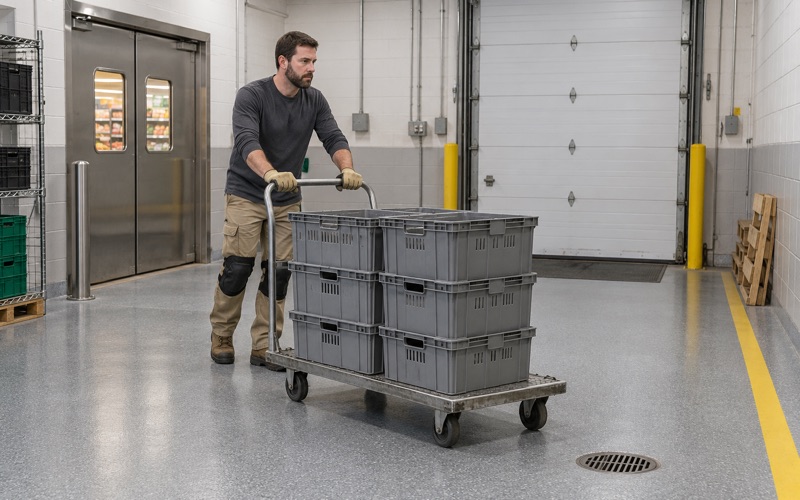
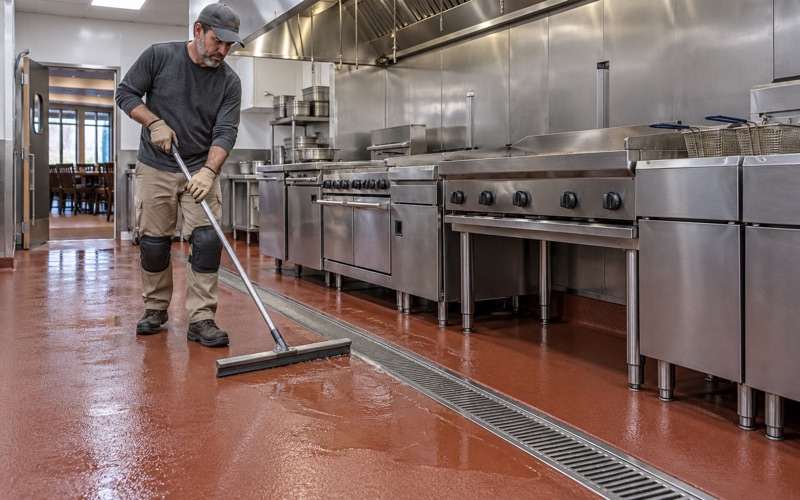
If a project involves replacing a slab rather than coating one, we check with the City of Muskego building inspection office at city hall on Racine Avenue before scheduling, because a new slab and a new coating are different permit questions. For a shop that may add a food line or a small kitchen, plan review runs through Waukesha County Environmental Health, and we plan coved bases and drainage slopes around that review.
- 20+ Years Coating Concrete
- Moisture Testing in Every Scope
- Written Contract Before Any Deposit