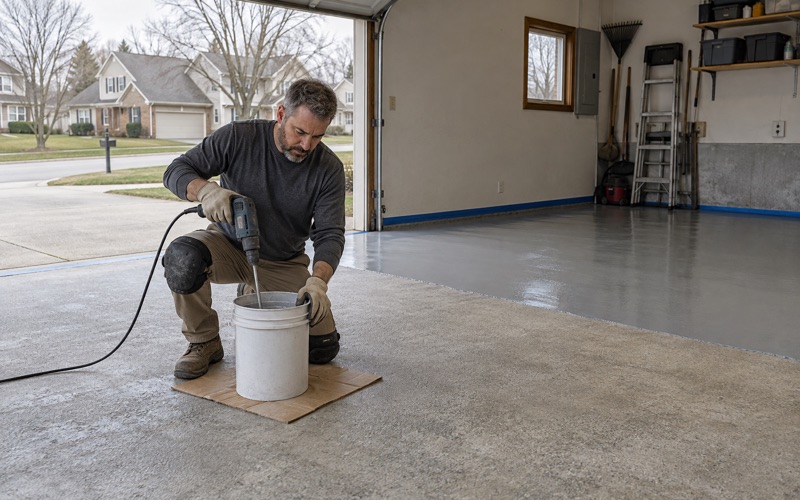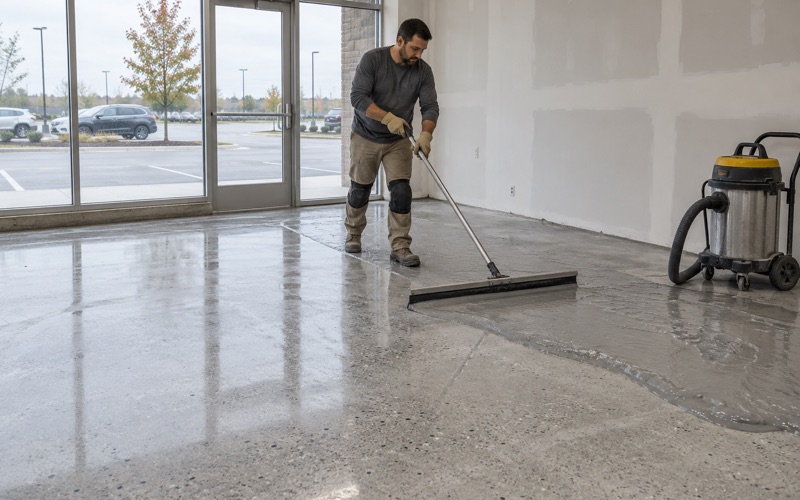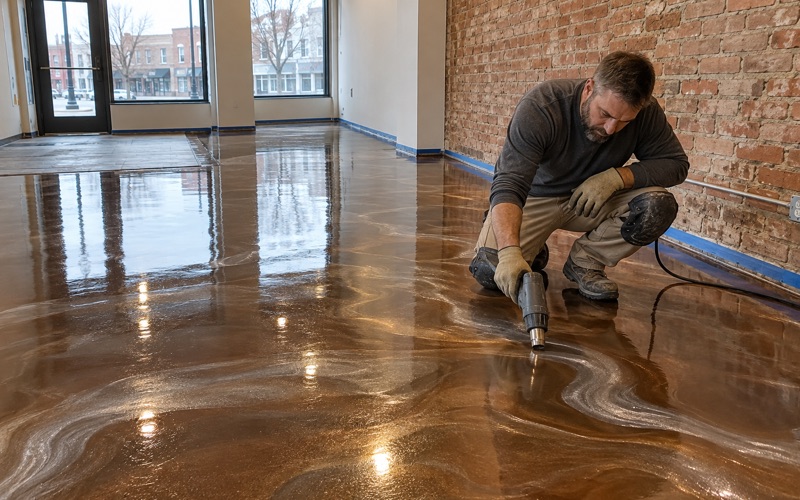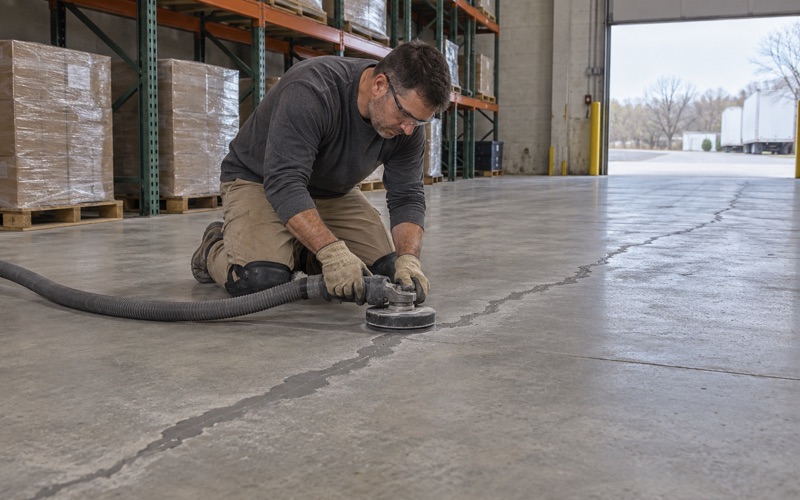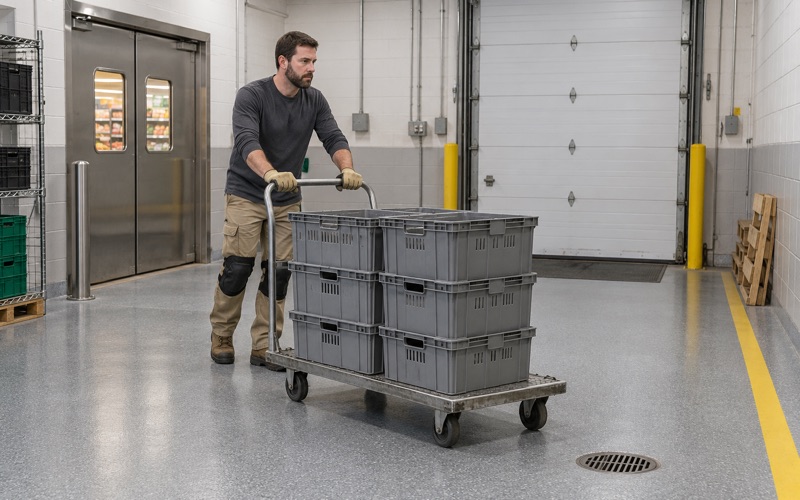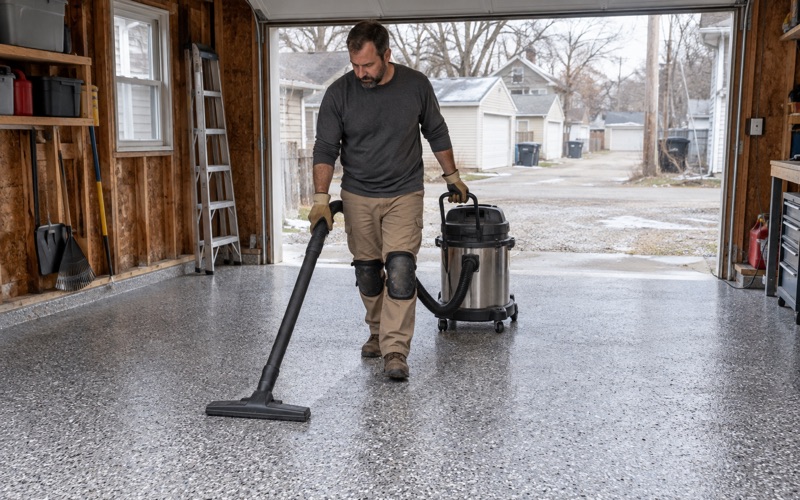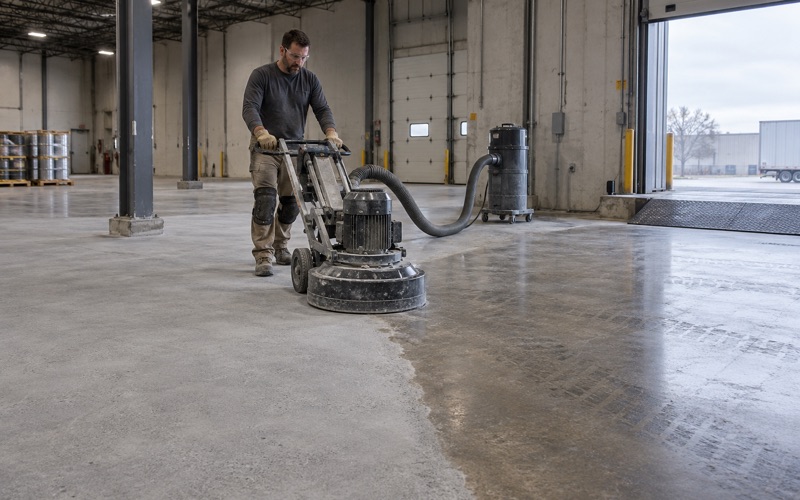
Waukesha Epoxy Flooring has spent more than 20 years installing epoxy-flooring in New Berlin plants, shops, warehouses and garages, and every job begins the same way: a diamond grinder or shot blaster opens the slab before any resin touches it. We do not acid etch. A mechanically profiled surface, measured against the ICRI CSP scale, is what a 100% solids epoxy actually grips.
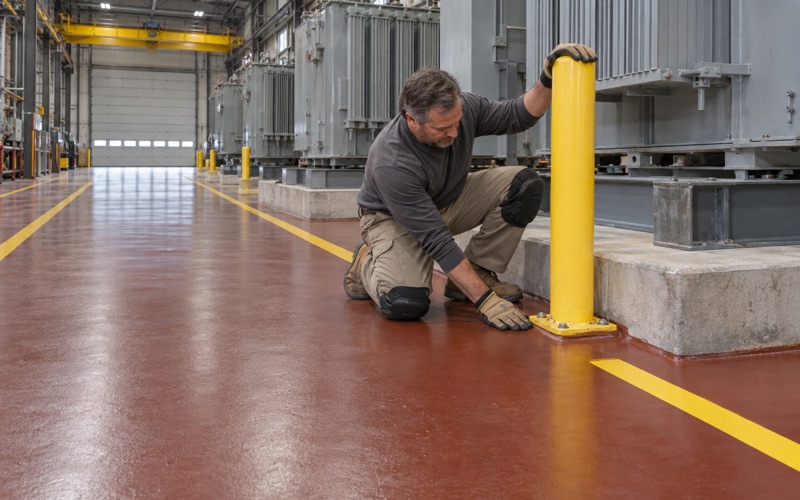
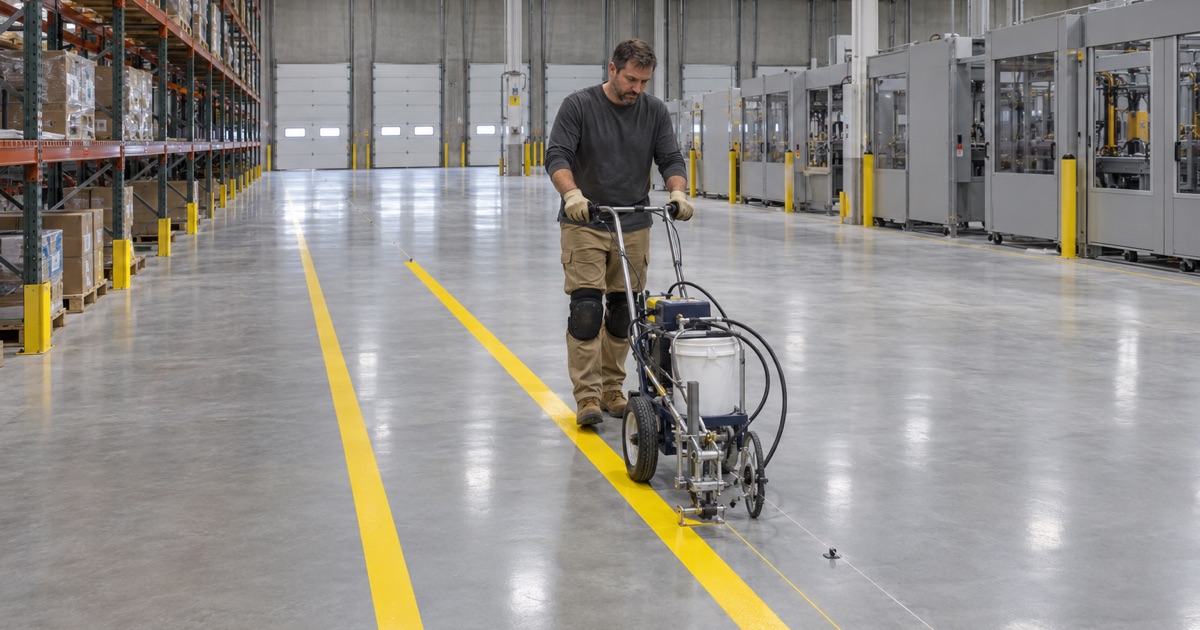
On a production floor, the coating is only part of what we quote. The striping plan for aisles, walkways and crossings is drawn into the same scope as the base coat and the topcoat, so the lines go down as part of the system rather than as paint applied over a finished floor months later.
Every proposal names the product, the system build and the finished thickness. That lets a plant manager or a homeowner check what was quoted against what went down, and it lets us say plainly, before any deposit, when a cracked or heaved slab needs repair or replacement before a coating will hold.
Coating Floors in New Berlin’s Business Parks
New Berlin is a city in eastern Waukesha County, part of the Milwaukee metropolitan area, with 40,451 residents at the 2020 census. Its industrial base is larger than that figure suggests: three business parks, Moorland Road, the New Berlin Industrial Park and MSI/Lincoln Avenue, total 1,126 acres of manufacturing, warehouse and service buildings.
The New Berlin Industrial Park dates to 1964, when the city began buying the land, eventually 620 acres; by 1967, 47 businesses had bought sites there. Older buildings in parks like that tend to carry slabs with years of lift-truck traffic, earlier coatings and patch repairs, so we read every crack, joint and old film before we put a number on the work.
A Large Plant Proposed on South Moorland Road
In April 2026, Rockwell Automation filed zoning applications for a facility of about one million square feet off South Moorland Road between Grange and College Avenues. The company said the site would integrate advanced automation, robotics and digital technologies, and that it had the potential to become its largest manufacturing site globally.
BizTimes reported in June 2026 that the plan includes about 770,000 square feet of warehouse and manufacturing space, proposed to operate 24 hours a day, seven days a week. The Plan Commission recommended approval on July 15, and the Common Council unanimously approved the land-use amendment and rezoning on July 28, 2026. Published reports have differed on the exact size and acreage.
We have no role in that project and make no claim about its floors. We raise it because it puts a practical question in front of every plant owner along the Moorland Road corridor and beyond: what happens to floor maintenance when a building is planned around never closing?
When a Building Never Shuts Down
A plant that runs 24/7 has no routine weekend or holiday shutdown in which to grind, recoat or re-stripe a floor. Whatever goes down at the start has to last, and any later work has to be phased zone by zone while production keeps moving around the barricades.
For operating plants, we plan the coating in sections, often in overnight or weekend windows, with each zone isolated, ground, coated and cured before traffic returns. Cure is scheduled against slab temperature and the dew point spread at the surface rather than the clock, because amine blush or a soft film under a lift truck costs more downtime than a rushed reopening saves.
Grinding dust and slurry are collected on site and never sent down a floor drain or into a storm sewer. In a building that stays open during the work, dust control is also what keeps a coating job from turning into a housekeeping problem for the production line running next to it.
Looking for epoxy-flooring closer to Brookfield? See Brookfield Epoxy-Flooring.
Aisle Marking Belongs in the Floor Specification
On a floor shared by lift trucks, carts, automated equipment and people on foot, aisle marking is not decoration. It tells every driver and pedestrian where travel is expected, and in a plant that never closes, the lines laid down at the start may be the lines the building works with for years.
What OSHA 1910.176 Requires, and What It Leaves to You
Wisconsin private-sector workplaces fall under federal OSHA. Under 29 CFR 1910.176(a), where mechanical handling equipment is used, sufficient safe clearances must be allowed for aisles, at loading docks, through doorways and wherever turns or passage must be made. Aisles and passageways must be kept clear and in good repair, and permanent aisles and passageways must be appropriately marked.
The rule stops there. It sets no stripe width and no color, so the widths, the colors and the layout are decisions the operator makes for its own traffic. We work from the plant’s layout and build the floor to it, and we do not present any particular width or color as an OSHA requirement, because the standard does not contain one.
Laying Out Mixed Traffic
Where automated vehicles, lift trucks and foot traffic share a floor, a marking plan usually separates them: travel lanes for equipment, walkways for people, and marked crossings where the two meet. Turns, doorways and dock approaches deserve the closest attention, since those are the very places the rule names for safe clearance.
We ask for the layout before we write the system, because it changes the build. Lines can be laid into the system before the final topcoat so they wear with the floor instead of sitting on top of it, and a polyaspartic or urethane topcoat over the striping helps it hold up under the turning wheels that scuff a surface-painted line first.
Joints, Wear and Re-Striping
Plant joints get a semirigid filler before any coating goes over them, so hard wheels roll across instead of breaking the edges. A chipped joint along a travel lane is where coating failure usually starts, and on a floor that cannot close, repairing one means barricading a live aisle.
Re-striping a worn lane later is possible, but without a shutdown window it has to be phased like any other floor work: a section closed, prepared, marked and cured while traffic is rerouted. That is why we would rather settle the marking plan on paper before the first coat than revisit it with lift trucks waiting.
Garage Floors in New Berlin’s Detached Homes
Most of New Berlin’s housing is owner-occupied detached homes, 11,670 of the city’s 13,047 owner-occupied units in Census survey estimates. The single largest decade of construction was the 1990s, with 3,019 homes, followed by the 1970s and the 1960s, so a typical call involves a garage slab that has already seen many winters of salt, oil and wear.
Testing Before a Garage Is Coated
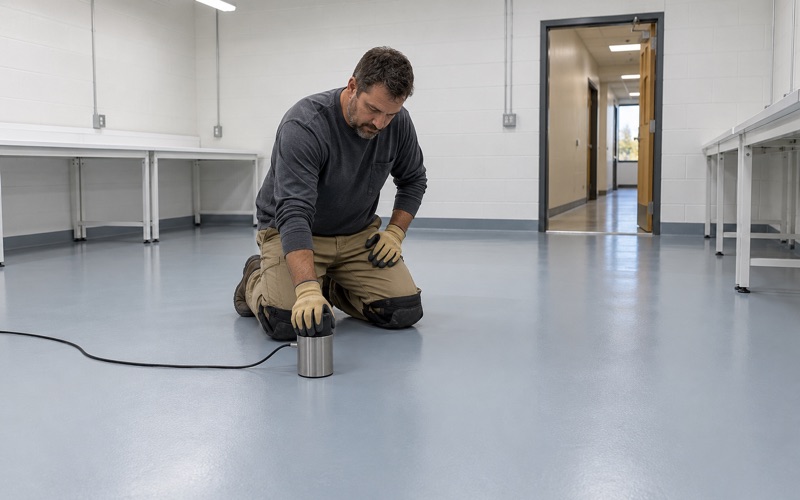
Wisconsin’s dwelling code does not require a vapor retarder under an unconditioned attached garage slab, the exception written into SPS 322.38. A dry-looking garage floor can still be moving moisture, so testing is a line item in our scope, using ASTM F1869 calcium chloride kits or ASTM F2170 in-situ relative humidity probes, before anything is sold.
Warranty exclusions are read out before the job is agreed, and moisture from below is the first one we name. We also do not sell a floor coating as radon reduction or as a fix for water coming up through a slab. If testing shows that kind of problem, we say so and price a moisture-mitigation primer or recommend other work first.
Built for Winter Brine
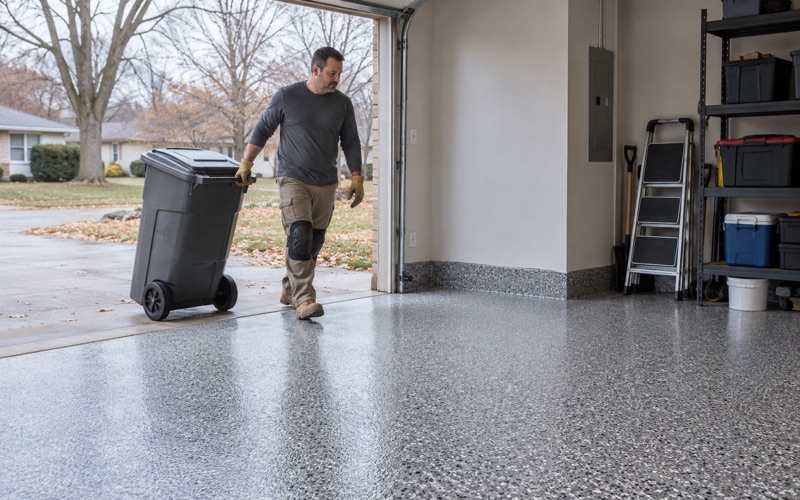
A New Berlin garage takes in road salt and calcium chloride brine on the tires all winter. We build home garage floors for that exposure, typically a 100% solids epoxy base with a vinyl flake broadcast and a polyaspartic topcoat, which also resists the hot tire pickup that lifts weaker coatings off a garage floor in summer.
Curing follows slab temperature and dew point rather than the calendar. An unheated garage in a cold stretch may have to wait for spring, and we say that plainly instead of coating a slab too cold to cure properly. Every home job gets a written contract before a deposit is taken, with the products and any warranty spelled out in it.
Permits Through the Department of Community Development
Coating an existing slab and replacing one are different questions, so we ask the city whether a job needs a permit before it goes on the schedule. In New Berlin, that is the Department of Community Development, on the second floor of City Hall at 3805 S. Casper Drive, which issues building, electrical, HVAC, plumbing, grading and erosion-control permits.
Where a home garage slab has to come out and be replaced first, the work falls under the Wisconsin Uniform Dwelling Code, and a one- or two-family permit is pulled by a holder of the state’s Dwelling Contractor certification. Wisconsin has no state license for floor coating itself. Inspections in New Berlin are scheduled at least 24 hours ahead at 262-797-2445.
For a coating inside an existing plant or warehouse, our part is usually narrower: confirm with the city what applies, agree the marking layout with the operator, then phase the work around the hours the building has to keep running. Larger land-use questions belong to the Plan Commission and Common Council, not to a flooring contractor.
- 20+ Years Coating Concrete
- Moisture Testing in Every Scope
- Written Contract Before Any Deposit