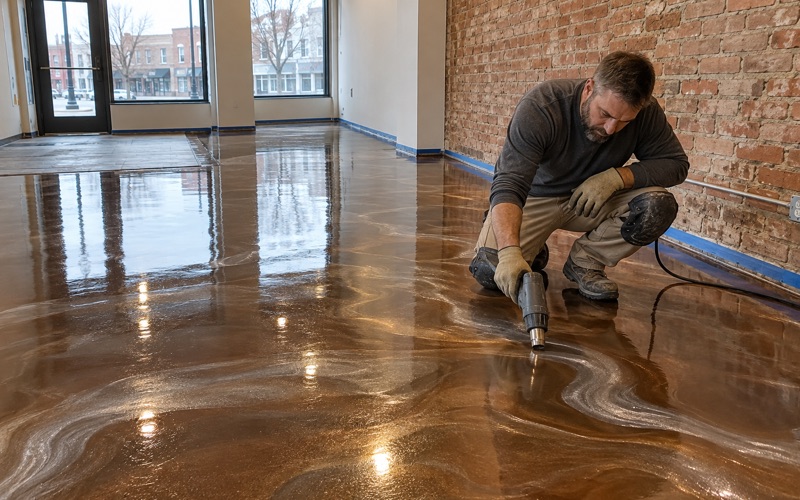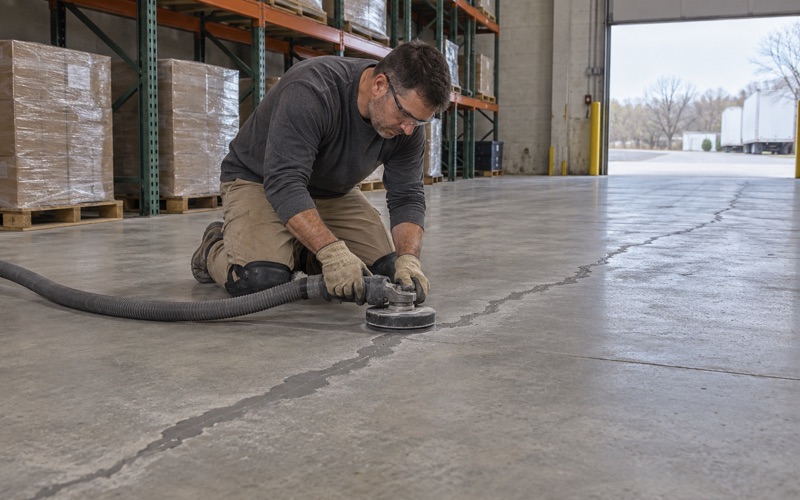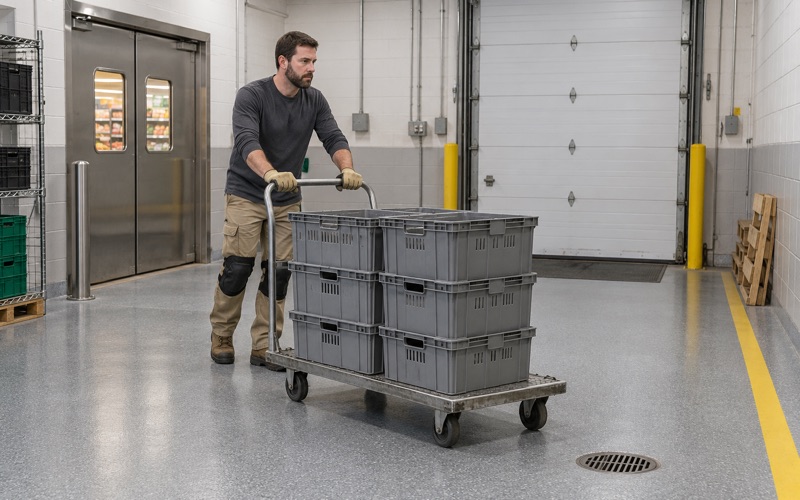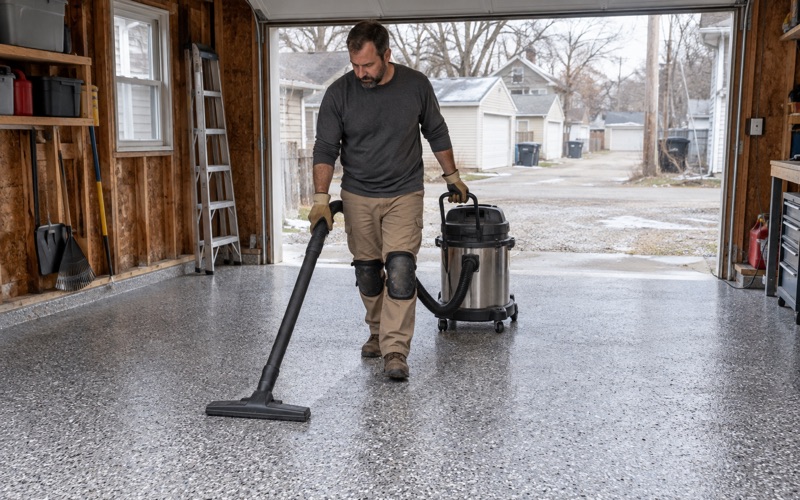
Waukesha Epoxy Flooring has spent more than 20 years on epoxy flooring in Oconomowoc and the rest of the county, and the work here runs from two-car garages to commercial buildings where a resinous floor is one surface among several. Every job starts the same way: we look at the slab before we price it. Cracks, control joints and any old coating tell us whether the concrete can take a coating as it stands.
When it cannot, we say so in the quote. A slab that needs repair or replacement first is far cheaper to hear about before a deposit than after a floor lets go. Our proposals name the product, the system build and the finished thickness, so a homeowner or a facilities manager can check what went down against what was sold.
Commercial work in this city is being shaped by one approved project in particular, and most of this page is about how a coated floor fits into a building with many different activity surfaces. Further down, we cover the garages and outbuildings on residential lots, where the questions are simpler but the testing is just as strict.
From Olympia Resort to One Building With Many Floors
The former Olympia Resort at 1350 Royale Mile Road closed in 2018. On September 2, 2025, the Oconomowoc Common Council authorized a development agreement with Neumann Developments for The Social, an entertainment complex planned for the old resort grounds, including the historic ski hill and chalet. The site sits inside Tax Increment District No. 7, which the city created in November 2020.
The agreement asks the project to generate about $50.6 million in new property value. Against that, the city pays $3.75 million for public improvements, including a new Snyder Way road, and $6 million in incentives. No construction start or opening date was published with the approval, so anyone planning floors for the building is planning ahead of a schedule that does not yet exist.
What goes under one roof
The Social is planned as a single building of 60,000 square feet. Inside it, the plan lists bowling, golf simulators, ax throwing, rock climbing and indoor pickleball, plus a full-service restaurant, a sports-viewing venue, a coffee shop, an ice cream parlor and a cocktail lounge. Outdoors, the plan adds sand volleyball and snow tubing.
Each of those indoor activities comes with a floor of its own. Bowling lanes and their approaches are a specialty surface built by lane suppliers. Pickleball courts get sport surfacing, and climbing walls sit over impact matting. None of those is a job for an epoxy crew, and we would not quote one as if it were.
What that leaves for a resinous system
What a resinous floor does in a building like this is fill the space between those surfaces. Corridors, the routes staff use to move food and equipment, storage rooms, mechanical rooms and restrooms all need a hard, cleanable floor that stands up to carts and foot traffic. In a multi-activity building, that is a lot of floor, broken into many small pieces.
That is why square footage alone says little about the work. A 60,000-square-foot building split into a dozen activity zones has many edges where a coated floor meets something else. Those edges decide the layout, the joint work and the schedule as much as the area does, and they are where a floor most often fails first.
Looking for epoxy-flooring closer to Martin Drive? See Epoxy-Flooring Services in Martin Drive.
Corridors, Service Routes and Back-of-House Rooms
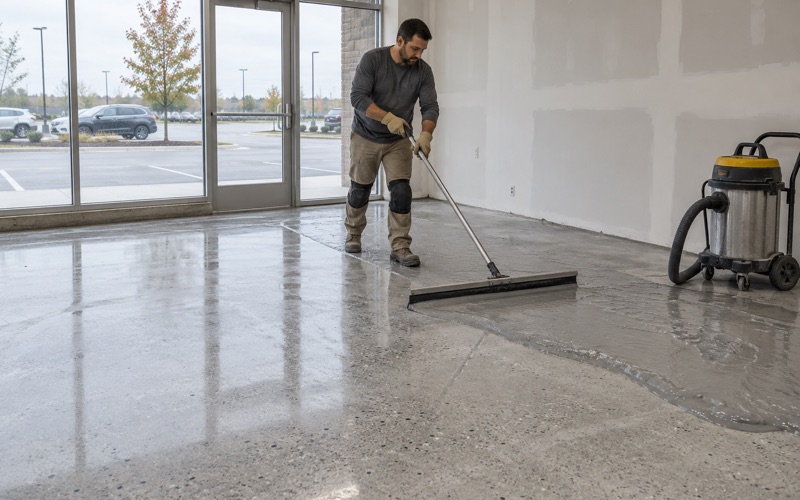
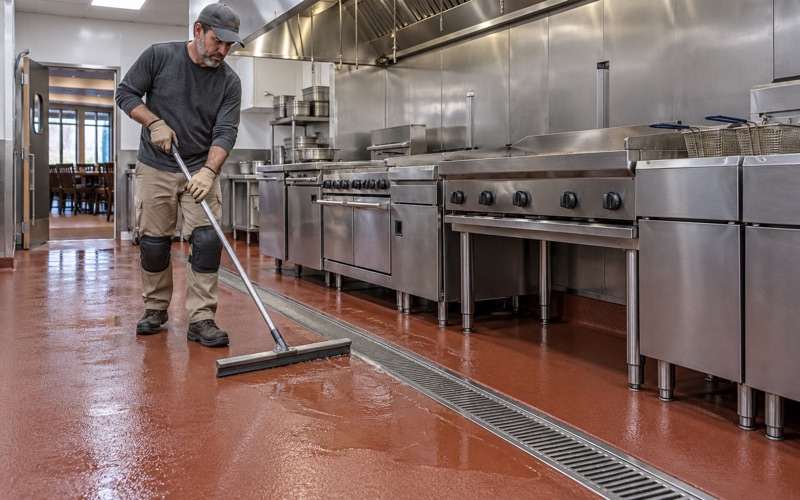
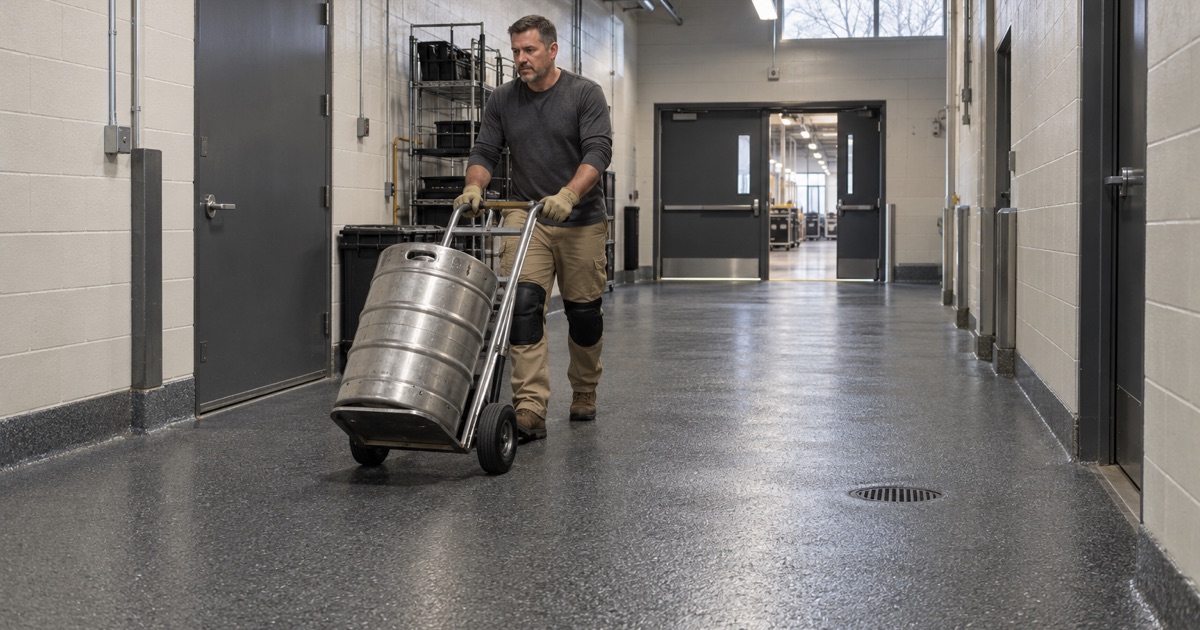
Circulation floors in an entertainment building take a mix of traffic that a garage never sees. Guests walk in on wet shoes from snow or a sand court, staff push loaded carts, and cleaning crews run scrubbers every night. For that load we would usually specify a 100% solids epoxy base with a quartz aggregate broadcast for grip, finished with a polyaspartic or urethane topcoat chosen for the traffic.
Opening the slab first
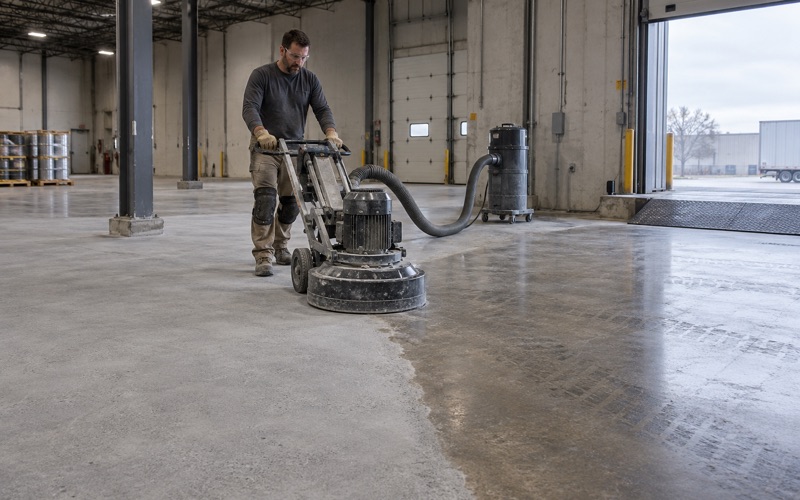
Before any of that, the concrete has to be opened. We do it mechanically, by diamond grinding or shot blasting, to an ICRI CSP profile matched to the system, and we never acid etch. Grinding dust and slurry are collected on site and kept out of floor drains and storm sewers, which matters on a new building with fresh plumbing.
Product choice also has an air-quality side. The part of Waukesha County north of I-94 and east of Highway 67 falls inside the Milwaukee 2015 ozone nonattainment area, and Highway 67 runs through the city, so we check where an address sits rather than assume. The products we specify are chosen within the national VOC limits of 40 CFR 59 Subpart D.
Joints, carts and new concrete
Service routes are where carts and pallet jacks cross control joints hundreds of times a day. We fill those joints with a semirigid filler before the coating goes over them, so wheels roll across a supported edge instead of chipping an open one. On new construction, the timing of that fill matters, because a slab keeps shrinking for months after it is poured.
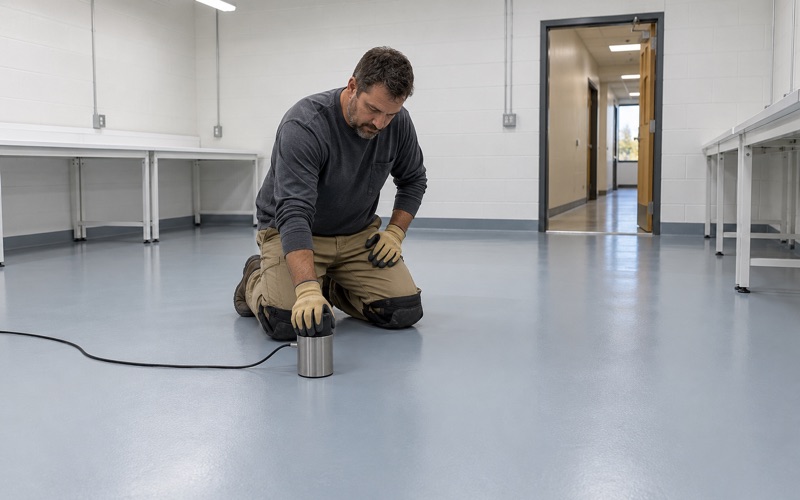
New concrete also carries moisture, and a coating laid over a wet slab can blister or lose its bond. Moisture testing is a line item in our scope, using ASTM F2170 in-situ relative humidity probes or ASTM F1869 calcium chloride tests, read against the manufacturer’s limits. Where readings run high, a moisture-mitigation primer goes into the proposal before anything else.
Working around the hours
Commercial floors in a working building rarely get a clean, empty week. When back-of-house rooms or corridors are recoated after a building opens, we schedule around the hours it has to run, including overnight and weekend windows. Fast-cure polyaspartic topcoats help here, though the base coats still need their full cure before carts return.
Cure itself is set by conditions, not the calendar. We track slab temperature and the dew point spread at the slab surface, because a cold slab under humid air invites amine blush on epoxy. In a large building with doors opening to winter air, that reading can differ from one corridor to the next.
Planning the Transitions to Lanes, Courts and Climbing Areas
A coated corridor that ends at a bowling approach, a court or a climbing area needs a finished edge that both trades agree on. The usual answer is a sawcut or a terminating groove where the resinous system stops, so the coating locks into the slab instead of feathering out to a thin lip that peels. We plan those terminations before the first coat goes down.
Matching heights at the edge
Each specialty surface has its own build height, and a coated floor has a finished thickness we state in the proposal. If the two do not meet flush, the result is a trip edge or a lip that catches cart wheels. We coordinate the finished elevation with the other trade’s numbers, and where the heights differ, a transition strip or a thicker build at the edge closes the gap.
Who goes first
Sequence matters as much as height. Grinding throws dust, and coatings give off vapor while they cure, so a resinous floor next to a finished lane or court is usually laid before the specialty surface arrives, or with that area sealed off. We set that order with the general contractor rather than discover it on the day.
Ax throwing and climbing zones add their own rules. Targets and walls sit inside their own footprint, and the floor outside them still takes foot traffic, spilled drinks and nightly cleaning. We treat the boundary of each zone as its own edge detail, with the coating terminated cleanly and the joint filled, rather than running one continuous film under everything.
Cleaning also crosses those edges. Scrubber water and mop water should stop at the coated floor rather than run onto a court or into a lane approach, so we look at how each transition will be cleaned before choosing the edge detail. A sealed, well-placed termination can keep wash water on the side of the line built to take it.
Color and wayfinding
A floor in a building with many destinations can do some of the directing. Vinyl flake broadcast and solid-color zones can mark staff routes, guest corridors and restricted rooms without extra signs. Any color plan stays separate from the specialty surfaces, which carry their own markings from their own suppliers.
Oconomowoc Garages and Lake-Lot Outbuildings
Most of the floors we coat in Oconomowoc are residential. Census estimates count 5,129 detached single-family homes in the city, and more than 3,500 of its 8,025 housing units were built in 1990 or later. Wisconsin does not require a vapor retarder under an unconditioned attached garage slab, so a newer garage floor that looks dry still gets tested before we coat it.
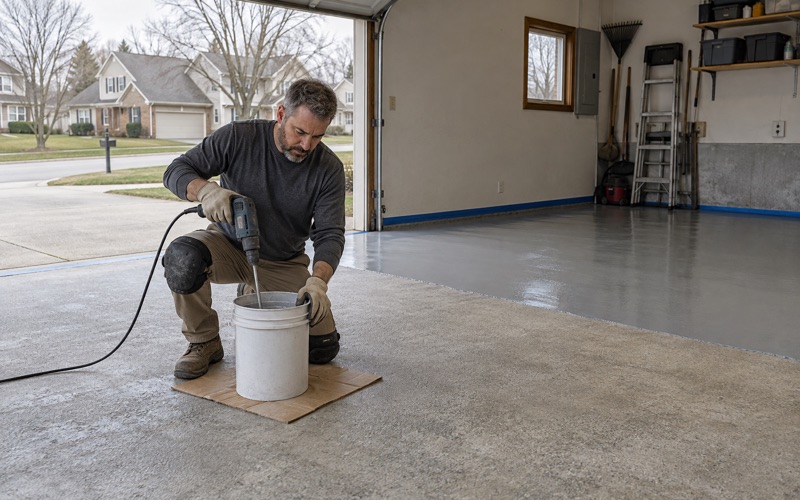
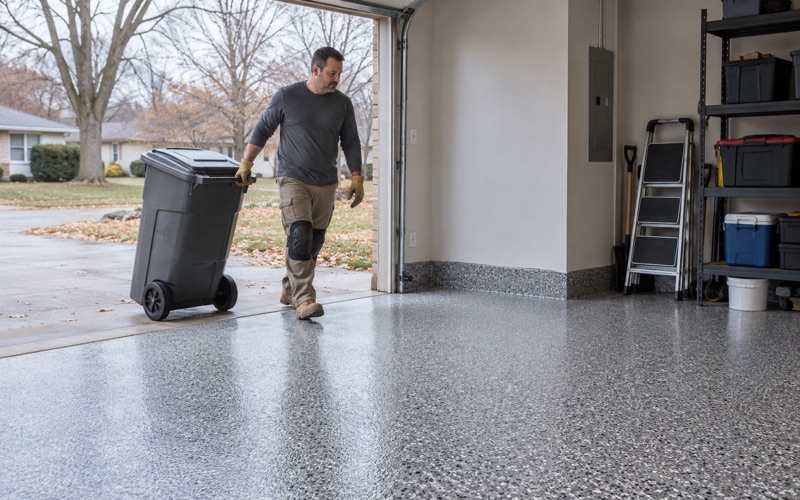
Garage floors here take the same punishment as anywhere in the county: road salt and calcium chloride brine dripping off tires all winter. We build garage systems for that, with a ground profile, a 100% solids epoxy or polyurea base and a topcoat that resists hot tire pickup. When an unheated garage is too cold to cure a coating properly, we say so and book it for spring.
Detached buildings on residential lots
Many lots also carry a detached garage or workshop. Under Chapter 17 of the city’s zoning code, a residential lot may have no more than two detached accessory buildings, and each must sit 10 feet from the house, or as close as 5 feet with special provisions such as a fire wall. A new one needs a building permit with a scaled site plan.
Those rules govern the building, not its floor coating. Coating an existing slab and pouring a new one are different questions, so we ask City of Oconomowoc Building Inspection whether a particular job needs a permit before we schedule it. For a new outbuilding, the slab has to cure fully and pass a moisture test before any coating goes on.
Boats, piers and storage floors
Lake-lot owners often use an outbuilding to winter a boat, store pier sections or keep a trailer between trips to the city launches on Lac La Belle and Fowler Lake. Those floors see fuel drips, wet equipment and point loads from trailer jacks. A quartz-broadcast epoxy under a chemical-resistant topcoat handles that far better than a thin roll-on paint.
Warranty exclusions come up before the job is sold, not after. Moisture from below is named first, because a coating cannot hold back water rising through a slab, and we do not sell one as a radon or water fix. Every home job gets a written contract, with the products and any warranty written in, before we take a deposit.
- 20+ Years Coating Concrete
- Moisture Testing in Every Scope
- Written Contract Before Any Deposit