Waukesha Epoxy Flooring installs polyaspartic floor coating systems in Waukesha, WI, serving surrounding cities including Pewaukee, New Berlin, Brookfield, Hartland and Delafield. Over more than 20 years of coating concrete we have watched polyaspartic move from a specialty product to the topcoat we reach for most often on garage floors, because it cures quickly, stays clear in sunlight and stands up to the grit and salt a Wisconsin winter brings in on the tires.
A fast-curing coating is only as good as the slab it bonds to, so the speed of the chemistry never shortens the prep. Every floor is opened with a diamond grinder or shot blaster, moisture is tested as a written line item, and cracks and joints are repaired before anything is mixed. The proposal names the products in each layer, the system build and the finished thickness, so you can check the floor against the quote.
We also say plainly where polyaspartic is not the right answer. A slab pushing moisture, a floor that needs a thick self-leveling build, or a kitchen with hot washdown may call for a different system, and we would rather tell you that before the job than replace a floor after it.
What Polyaspartic Brings to a Floor System
Fast Cure Without Skipping Steps
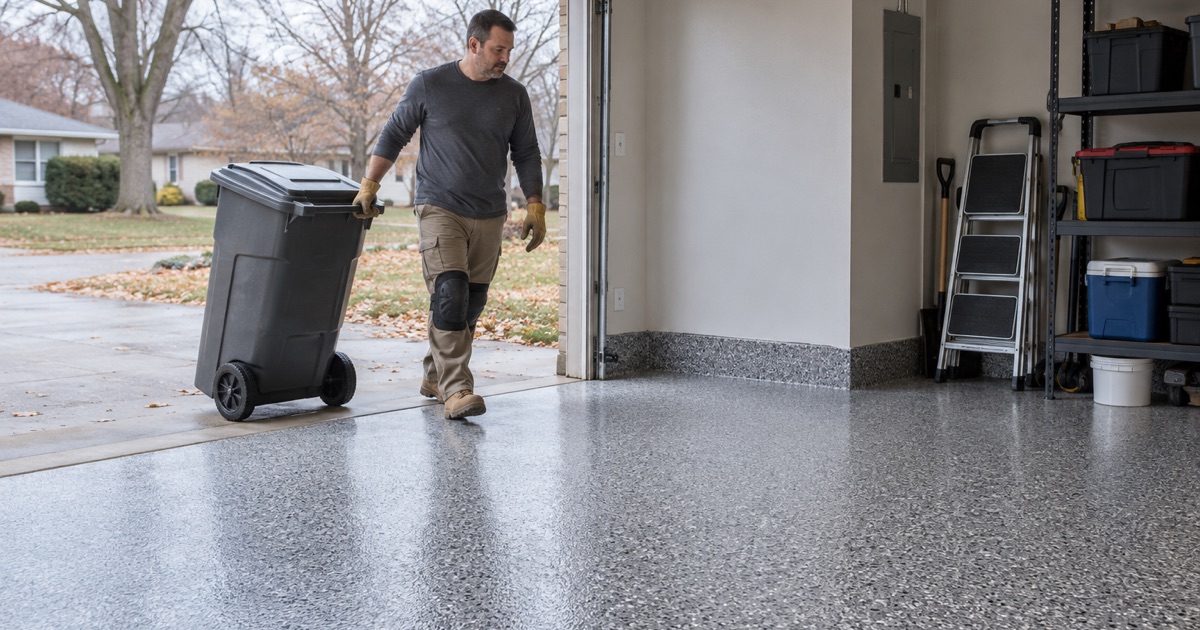
Polyaspartic is a type of aliphatic polyurea that cures much faster than a conventional epoxy, often allowing a recoat in hours rather than overnight. On a garage floor that means the base, broadcast and topcoat can be completed in a shorter window and the space returned to foot traffic sooner. For homeowners who park outside during the job, that difference matters most in the colder months.
The tradeoff is a short working time once the material is mixed. Crews have to move with it, and a rushed or poorly prepared slab shows every flaw because the coating locks in quickly. That is why the grinding, crack filling and moisture work happen first, at their own pace, before the clock on the polyaspartic starts.
UV Stability and Color That Holds
Many epoxies amber when sunlight hits them, and on a light gray flake floor or a pale solid color that yellowing shows within a season or two near the door. Aliphatic polyaspartic and polyurea topcoats resist ultraviolet light, so the color you chose stays the color you see. On garages with a sunny open door, that alone often decides the topcoat.
That same stability makes polyaspartic the usual clear coat over decorative flake and quartz broadcasts. It locks the chips in place, adds a wear layer on top, and keeps the finish from looking tired in the tire paths where sunlight and traffic meet.
Abrasion and Hot Tire Resistance
Hot tire pickup happens when a warm tire softens a coating and pulls it off the floor as the car cools and drives away. A properly cured polyaspartic topcoat resists that far better than a thin epoxy, and it also holds up to the sand and grit that collects on a Waukesha garage floor through the winter.
We pair that hardness with texture. A full flake broadcast under the topcoat, or a fine aggregate in it, gives tires and boots grip when snowmelt pools on the floor, rather than a slick gloss surface that looks good dry and is treacherous wet.
Building a Polyaspartic System on Local Slabs
Grinding, Repair and the Base Coat
We grind every slab to a measured concrete surface profile, removing sealers, laitance and stains so the system bonds to sound concrete. Cracks are routed and filled, spalls near the door are rebuilt, and control joints are either honored or filled depending on the system. None of that is skipped because the topcoat cures quickly.
The base layer is chosen for the slab. On many garages it is a 100% solids epoxy that builds thickness and wets out the ground surface well; on others it is a polyaspartic or polyurea base that suits a faster schedule. The proposal tells you which, so a full polyaspartic floor and a hybrid floor are never quoted as if they were the same thing.
Moisture Testing Before Any Coating
Wisconsin does not require a vapor retarder under an unconditioned attached garage slab, and many local garage floors sit directly on gravel. Moisture rising through that concrete will push any coating off, fast-curing or not, so we test before we coat using a plastic sheet test, calcium chloride testing or relative humidity probes as the slab calls for.
When the readings call for it, a moisture-mitigation primer goes down first and is priced into the proposal. A polyaspartic topcoat is not a vapor barrier, and we do not sell it as a fix for water coming up through a slab.
Curing Against Temperature and Dew Point
Polyaspartic tolerates cooler slabs than most epoxies, which is part of why it suits Wisconsin’s shoulder seasons. It is still a chemical reaction, and a slab sitting too close to the dew point collects a film of moisture that can cloud or weaken the bond. We measure slab temperature and the dew point spread at the surface before every coat.
In a heated garage or basement, polyaspartic can go down through the winter. In an unheated attached garage during a Waukesha cold snap, the honest answer is often to wait for spring, and we say so rather than coating a floor that will not cure the way the product sheet promises.
Where Polyaspartic Fits, and Where It Does Not
Garages, Shops and Basements
Polyaspartic is a strong fit for residential garages, workshops, hobby spaces and basements that are dry once tested. The fast return to service suits homeowners who need the garage back quickly, and the clear, UV-stable topcoat works well over flake, quartz and solid color. In basements, its low odor formulations and quick cure help keep disruption to the house short.
Commercial showrooms, auto service bays and light shop floors also benefit, especially where a short closure is worth more than the price difference between systems. We plan those jobs around the hours the building has to stay open.
Kitchens, Washdown and Heavy Chemical Rooms
In commercial kitchens and food plants with hot washdown, thermal shock and constant moisture, urethane cement usually outperforms a polyaspartic system. In rooms with strong acids or solvents, the chemical resistance chart for the specific product decides the choice. We put the reasoning in the proposal rather than using one coating for every room.
What a Polyaspartic System Costs
A polyaspartic floor usually costs more per square foot than an all-epoxy system, because the materials are more expensive and the short working time takes a larger, faster crew. What moves the number most, though, is the slab: how much grinding it needs, how many cracks and spalls have to be repaired, and whether the moisture readings call for a mitigation primer under everything else.
The broadcast also matters. A full vinyl flake broadcast to refusal uses far more chip than a light scatter, and a quartz floor uses more material again. We list each of those as its own line in the proposal, so you can compare a polyaspartic floor with a hybrid or an epoxy floor on the same terms rather than on a single total.
Recoating a Worn Polyaspartic Floor
After years of tires, grit and salt, the topcoat in the busiest lanes of a garage loses its gloss and starts to look scuffed. Because the wear is in the top layer, a well-bonded floor does not need to come up. We clean it, abrade the surface to give the new coat a profile to grip, and apply a fresh polyaspartic topcoat over the existing system.
That only works when the original layers are still bonded to the concrete. If a floor is lifting at the edges or blistering in patches, recoating would bury the problem, so we test the bond first and tell you whether the floor can be refreshed or needs to be ground off and rebuilt.
Warranty Terms and the Written Contract
Polyaspartic warranties, like all coating warranties, typically exclude damage caused by moisture from below the slab, along with impact and chemicals outside the rated list. We read those exclusions out before the job is sold and write the products and the warranty into the contract, which every homeowner receives before a deposit is taken.
- 20+ Years Coating Concrete
- Moisture Testing in Every Scope
- Written Contract Before Any Deposit