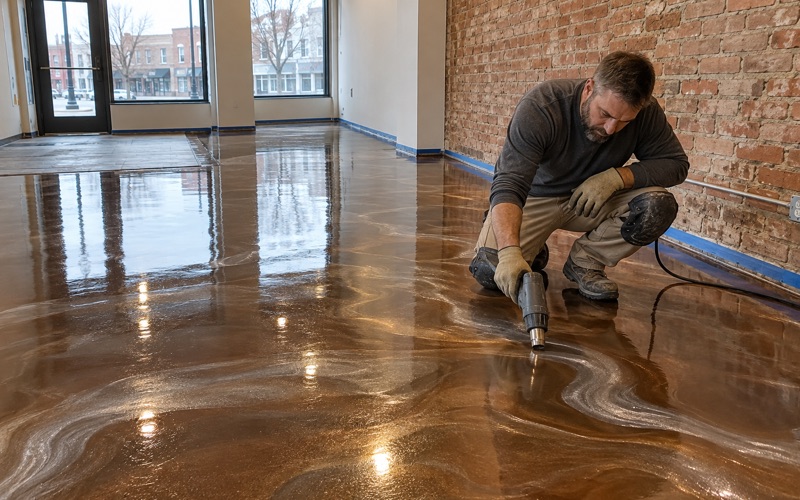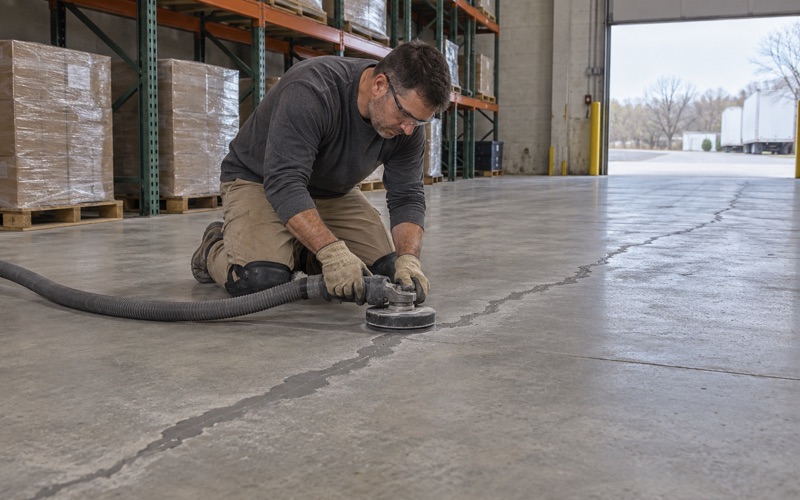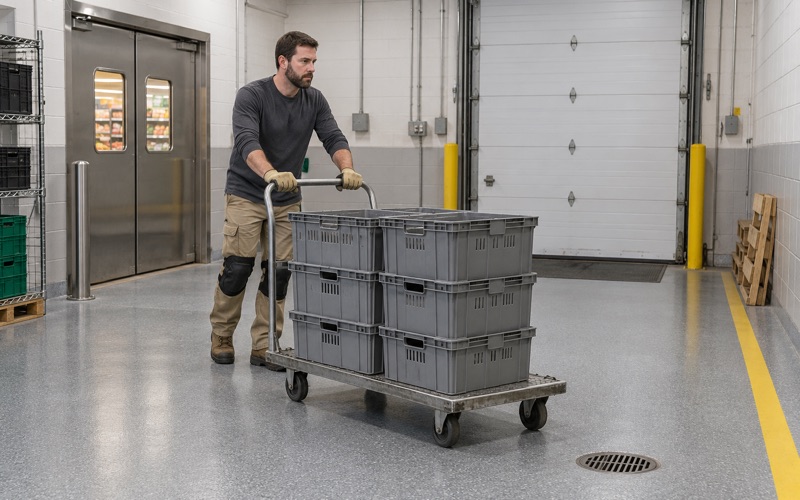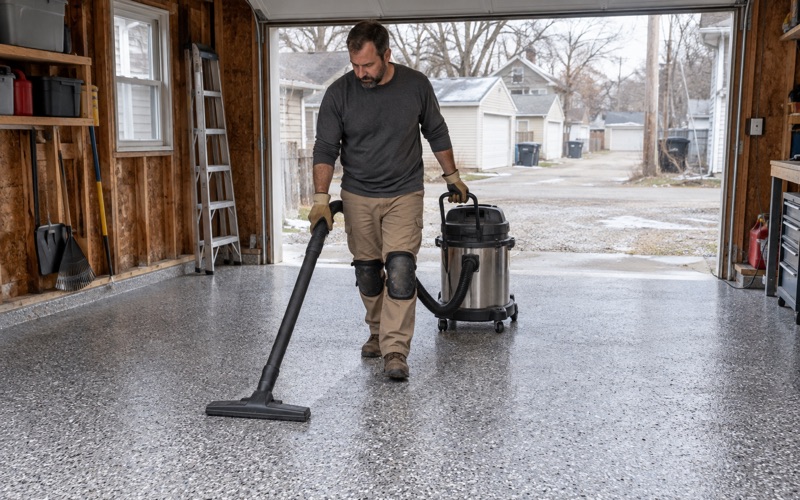
Waukesha Epoxy Flooring brings more than 20 years of floor coating experience to epoxy flooring in Shorewood, with much of our attention on the small service storefronts where a floor is swept, mopped and walked on from opening to close. Salons, studios and shops ask a floor to stay clean and intact under steady traffic, and the coating system has to be chosen for that work rather than for a showroom photo.
Before we quote, we look at the slab itself: the cracks, the saw cuts, any old coating and whatever was glued down before. When a floor needs repair or replacement before it can carry a coating, we say so plainly. Our proposal then names the product, the system build and the finished thickness, so an owner can check what was promised against what went down.
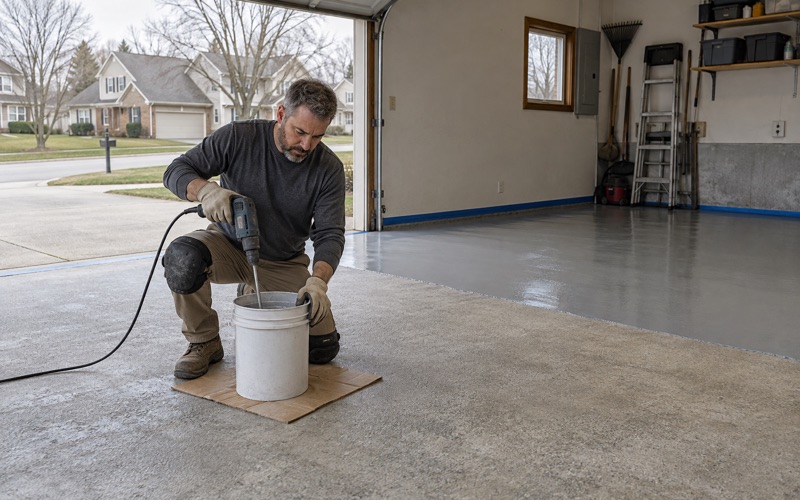
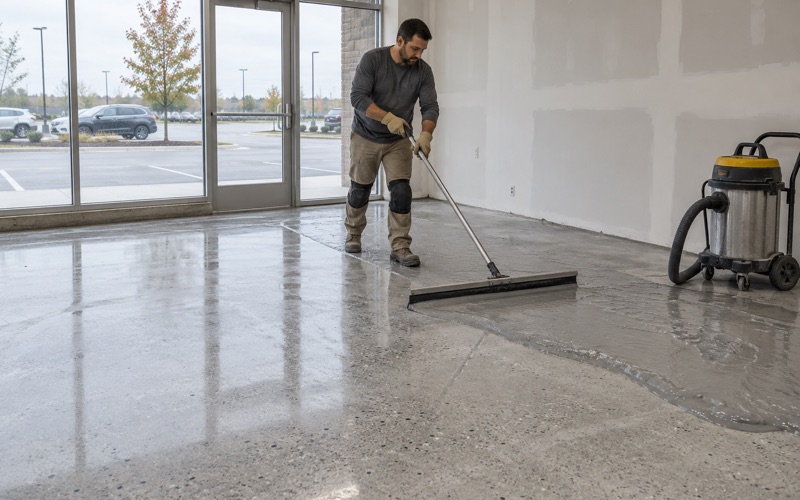
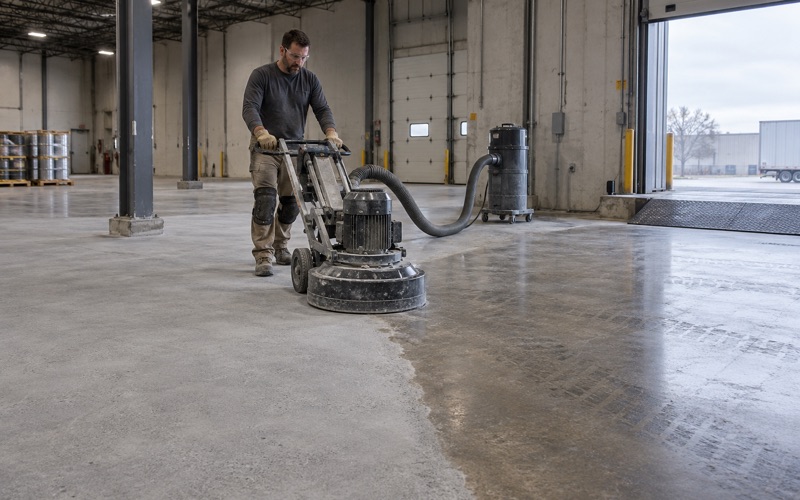
Every slab is opened with a diamond grinder or shot blaster, never acid etched, and moisture testing sits in the scope as its own line item. Grinding dust and slurry are collected on site rather than rinsed into a floor drain. Those habits matter most on a floor that has to look tidy and hold together through years of daily cleaning.
A Seven-Day Salon and the Rule Behind Its Floor
Oakland Avenue hours
The Establishment Salon at 4503 N. Oakland Avenue is a useful picture of what a Shorewood service floor is asked to do. Its listed hours run 9 a.m. to 7 p.m. Monday through Friday and 9 a.m. to 6 p.m. on weekends, and its menu covers hair, color, treatments, makeup, waxing, eyes and extensions. A floor in a shop like that rarely gets a quiet day.
We mention the salon as an example of the kind of business that lines the avenue, not as a job of ours; we have not seen or measured its floor. What it shows is the schedule. A coating for a seven-day storefront has to be planned so the work fits a closure window and the finish is ready when the chairs fill again.
That planning is part of how we work with any business that has to keep running. Shop, kitchen and clinic floors are scheduled around the hours the building must stay open, including overnight and weekend windows, and a salon fits the same pattern. Curing is set against slab temperature and the dew point rather than a calendar date, so the reopening day we give is a realistic one.
What Cos 3.01 says about floors
Wisconsin’s Cosmetology Examining Board is directed by Wis. Stat. 454.08(4) to set minimum standards for the maintenance and equipment of licensed establishments as they relate to public health and safety. Its rule carrying those standards is Cos 3.01, and floors are named in it directly rather than left to inference.
Cos 3.01(1) says an establishment, including its floors, walls, ceilings, furniture and equipment, shall at all times be in good repair and maintained in an orderly and sanitary condition. Cos 3.01(4) adds that all floor coverings shall be kept clean, orderly and safe, and that loose hair shall be removed regularly and placed in a closed container.
The rule asks for condition, not a product. It does not name epoxy, polyaspartic or any other system, and no coating makes a shop compliant by itself. What a well-built floor can do is make good repair easier to hold onto, because a sound, continuous surface is simpler to keep clean than one with chips, lifted edges and worn traffic lanes.
Looking for epoxy-flooring closer to Cudahy? See Epoxy-Flooring Services in Cudahy.
Clippings, Sweeping and a Surface With Nothing to Catch On
Why texture matters for fine hair
Cut hair is fine, light and constant, and it settles into whatever the floor offers it. Open joints, pitted concrete, a broken edge at an old coating and deep aggregate texture all hold clippings that a broom slides past. Under a rule that asks for loose hair to be removed regularly, a floor that releases hair on one pass is doing real work.
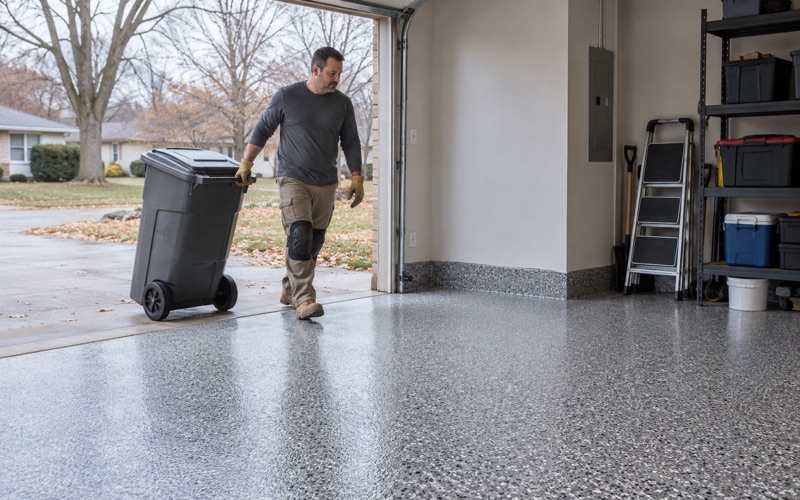
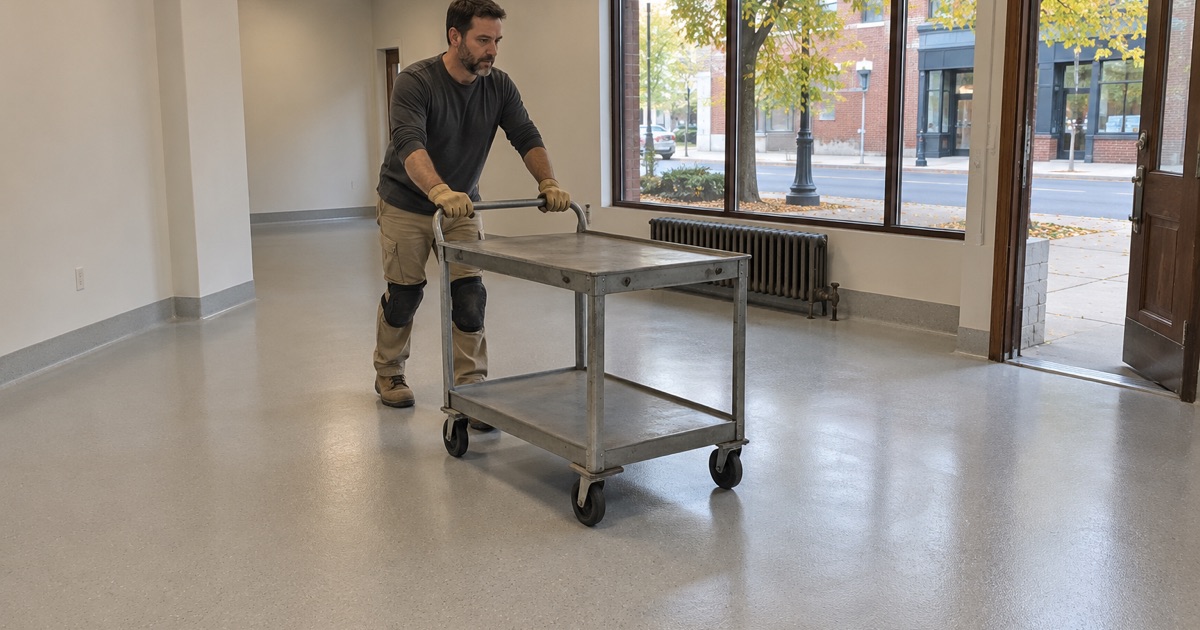
For a salon, that usually points toward a lighter broadcast and a topcoat that closes the surface well. A light vinyl flake broadcast locked under a polyaspartic or polyurea topcoat can give some grip without leaving a profile that grabs hair, and the build can be adjusted near wet areas where more texture is wanted. We talk through that balance before anything is ordered.
Joints, cracks and the closed-container routine
Saw cuts and cracks are where clippings collect first, so we deal with them before coating rather than bridging over them and hoping. Joints are filled with a semirigid joint filler that keeps the edges supported under rolling chairs and carts, and cracks are repaired where the slab allows it. If a slab is too far gone, we say that before quoting.
A floor that sweeps clean supports the routine the rule describes: hair gathered on the broom, into a dustpan and into a closed container, many times a day. We do not claim a coating handles that job for a shop. It simply removes the places where hair hides, so the sweep that staff already do actually finishes the job.
Surface prep that keeps the coating attached
None of that holds if the coating lets go. We open every slab mechanically, grinding or shot blasting to the ICRI CSP surface profile the chosen system calls for. A properly profiled slab gives a 100% solids epoxy base coat something to grip, which is what keeps edges from lifting and turning into hair traps a year or two later.
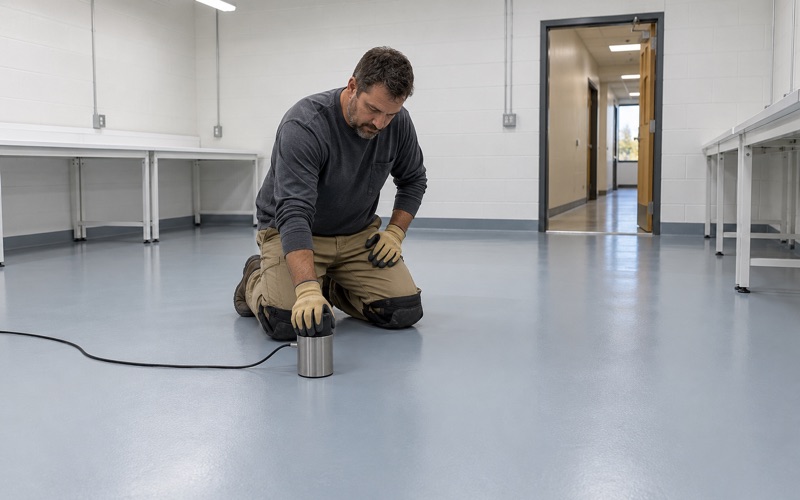
Moisture comes before any of it. We run an ASTM F2170 in-situ relative humidity test or an ASTM F1869 calcium chloride test, depending on the slab and the system, and read the result against the manufacturer’s limits. Where readings run high, a moisture-mitigation primer goes into the scope; we do not sell a coating as a fix for water rising through a slab.
Color Stations, Shampoo Basins and Wet Floors
The basin area
Cos 3.01(12) calls for a basin with hot and cold running water, and the floor around shampoo bowls sees the most water in a salon. Drips, splashes and mop water land there all day. We plan that zone with a little more texture in the broadcast so wet feet have something to work with, while keeping the surface tight enough to wipe and squeegee.
The edges matter as much as the open field. Where a coating stops at a cabinet base, a plumbing chase or a floor box, an unsealed edge lets water work under the system. We terminate those edges cleanly and keep the coating continuous across the basin zone, so mopping does not slowly lift a corner that later becomes both a chip and a place for hair to collect.
Color stations and spills
Color stations bring chemicals to the floor in small, frequent amounts. We have not tested any coating against hair color or lightener and do not promise a finish that resists them. What we can say is that a closed, nonporous topcoat lets a drip be wiped up before it soaks in, which bare or poorly sealed concrete does not allow.
When an owner wants a specific chemical-resistance figure, we go to the manufacturer’s published data for the exact product we propose and share it as the manufacturer states it. Choosing among 100% solids epoxy, polyaspartic topcoats and urethane cement is a conversation about what lands on the floor, how often it is cleaned and how quickly the shop needs to reopen.
Cleaning chemistry and the finish
Daily sanitizing is part of keeping a floor orderly and sanitary, and the cleaner matters. We hand over care guidance with the job that names cleaners suited to the topcoat, because some strong products dull or soften certain finishes over time. A topcoat kept in good shape is the layer that protects everything beneath it.
We also watch for amine blush on epoxy layers cured in cool, damp conditions, since a blushed surface can weaken the bond of the next coat. Scheduling the cure against the dew point spread at the slab surface is how we avoid it, and it is one reason we do not rush a recoat to save half a day.
Keeping a Shorewood Storefront Floor in Good Repair
Opening a new shop
For a business moving into a Shorewood storefront, the floor sits inside the village’s opening process. The Checklist for New Businesses asks for a Commercial Occupancy application with a Plan of Operations and scaled floor plans, reviewed by the Village of Shorewood Planning & Development Department at 3930 N. Murray Ave. Some uses, massage among them, are conditional and need Plan Commission approval first.
The occupancy inspection happens when the business is set to open, with all fixtures, equipment and furniture in place, and a business cannot open without a Certificate of Occupancy. That means a tenant floor has to be coated and cured before the stations and chairs go in, so we schedule the coating ahead of the fit-out rather than squeezing it in at the end.
Interior floors are not a Design Review Board matter in Shorewood; that board handles exterior signs and facades. If a storefront serves food or drink, the North Shore Health Department adds its own application and pre-occupancy review, and certain building improvements also need North Shore Fire Department plan review. We ask the village whether a job needs a permit before it is scheduled.
Renewals and worn paths
Shorewood businesses renew their occupancy certificate every five years under Code 225-20C(3)(b), and the village notifies a business when that renewal comes due. A renewal is a natural point to look at the floor with the same eye the cosmetology rule uses: is it still intact, still easy to clean and still free of worn paths?
A chipped coating or a traffic lane worn through to primer is a maintenance item under Cos 3.01, not only a cosmetic one. We look at the worn areas, test whether the existing system is still bonded, and recommend either a sand and fresh topcoat or a full removal where the base has failed. Warranty exclusions, with moisture from below named first, are read out before that work is sold.
Questions Shorewood owners ask
Owners usually ask how long the shop will be closed. The answer depends on the system and the slab temperature, but a polyaspartic topcoat can often shorten the return to service compared with a full epoxy build, and we explain that tradeoff in the proposal. Every home job also gets a written contract before any deposit, with the products and warranty written in.
The other common question is whether a coating counts as compliance. It does not; Cos 3.01 is satisfied by how the shop is kept, and the floor is one part of that. Our job is to give staff a surface that is sound, continuous and quick to sweep, so the rule’s standard of good repair is easier to keep every day of the week.
- 20+ Years Coating Concrete
- Moisture Testing in Every Scope
- Written Contract Before Any Deposit