Waukesha Epoxy Flooring has spent more than 20 years on epoxy flooring in Whitewater and the plants, shops and garages around our home base, and the floors we are asked about most here are working floors. A production slab takes daily abuse from wheels, spills and boots, and the coating has to be judged by how it behaves on a busy Tuesday, not how it looks the day it cures.
On a manufacturing floor, the question is rarely color. It is how fast a spill can be swept off, how well a boot grips while it is being swept, and whether the floor tells people where one area ends and the next begins. Those three answers decide the build, from the profile we grind to the aggregate we broadcast and the topcoat we finish with.
We quote that build in writing, with the product, the system layers and the finished thickness named, so a plant manager can hold the floor that went down against the proposal that was approved. Below is how we think through a molding-and-packing floor in Whitewater, using one of the city’s own plants as the example.
Korky Parts and Loose Pellets on Universal Boulevard
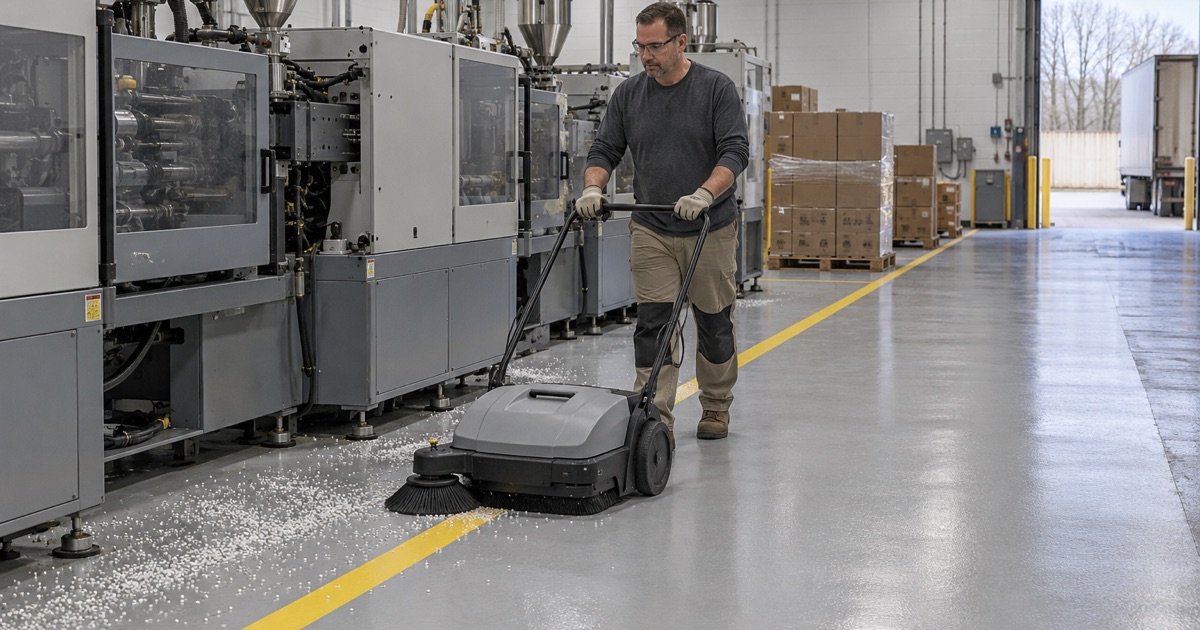
Whitewater is a city that spans Walworth and Jefferson counties, best known as the home of the University of Wisconsin-Whitewater. The plants along Universal Boulevard tell a different story about the place: a business park where parts are molded, assembled and shipped. It is the kind of floor that tests a coating hardest.
Molding, assembly and warehousing in one building
Lavelle Industries, the company behind the Korky line of toilet-repair parts, runs a Whitewater plant at 1215 Universal Boulevard. Its careers pages describe plastic and TPE injection molding, assembly, packaging and warehousing at the site, and they recruit molding operators across three shifts for a clean, climate-controlled facility. Lavelle is an example here, not a customer; we have not coated or inspected its floors.
The building also grew. In late 2014 Lavelle bought land next to the existing plant to expand it for Korky products and custom molded parts, with construction running into 2015. An expansion like that usually means new slab meeting old slab, and every seam where two pours meet is a joint that needs filling and a profile that needs matching before one coating can run across both.
Put molding, assembly, packing and storage under one roof and a single floor ends up doing four jobs. The press aisles see resin, oil and constant foot traffic; the assembly benches see carts; the packing line sees cardboard dust and pallet jacks; the warehouse sees forklifts. A floor coated as though it were one room will be wrong for at least three of those areas.
Why a pellet behaves like a ball bearing
Injection molding starts with resin delivered as small, hard pellets, and some of them always escape. They bounce out of a hopper during a material change, spill from a torn bag, or ride out on a sleeve. On a smooth, glossy floor a loose pellet behaves like a ball bearing under a boot heel, and a scatter of them near a press is a slip waiting to happen.
The usual instinct is to make the floor as rough as possible, but that creates a second problem. A deep, open texture grips a boot and also grips the pellets, holding them in its valleys where a broom rolls right over them. The floor then looks swept while it is still seeded with loose resin, which is worse than an obvious spill because nobody stops to deal with it.
Looking for epoxy-flooring closer to Elkhorn? See Epoxy-Flooring Services in Elkhorn.
What OSHA’s Walking-Surface Rule Asks of a Press Floor
The federal rule that governs this is 29 CFR 1910.22, the general requirements for walking-working surfaces. It does not name epoxy or any other coating, and no floor product is approved by OSHA. What the rule describes is a condition the floor has to be kept in, which is why the coating choice matters: some surfaces make that condition easy to keep and some make it hard.
Clean, orderly and free of spills
Paragraph (a)(1) says places of employment, passageways, storerooms and service rooms are to be kept clean, orderly and sanitary. Paragraph (a)(3) says walking-working surfaces are maintained free of hazards such as sharp or protruding objects, loose boards, corrosion, leaks, spills, snow and ice. Spilled resin pellets sit squarely inside that language, alongside the oil and coolant that weep from machinery.
Notice that storerooms are named alongside passageways. The packing and warehouse end of a molding plant is held to the same clean and orderly standard as the press aisle, so the floor there has to shed cardboard dust, shrink-wrap scraps and stray parts just as readily. A coating that sweeps clean in one zone and traps debris in another leaves a gap the rule does not allow for.
Inspect, correct, then reuse
Paragraph (d) asks that walking-working surfaces be inspected regularly and as needed, and that hazards be corrected or guarded before the surface is used again. On a press floor that inspection is mostly visual, and a floor has to make problems visible. A single light, even color shows a scatter of dark pellets or a fresh oil sheen at a glance.
Worn coating is a hazard of its own under that same inspection. A coating that has peeled at a press base or chipped along a joint edge creates a lip that catches cart wheels and a pocket that collects pellets. We read the cracks, joints and old coating before quoting, and when a slab needs repair or replacement before it can be coated, we say so plainly rather than coating over a defect.
Sweepable Texture That Still Grips
The goal on a molding floor is a texture fine enough that a broom or a sweeper carries a pellet off it, but coarse enough that a boot keeps its footing on oil or coolant. That balance is set in three places: the aggregate we broadcast, how much topcoat we lock it in with, and where on the floor each texture goes.
Choosing the broadcast and topcoat
For press aisles we usually build a 100% solids epoxy base with a fine quartz aggregate broadcast, then lock the grit in with a topcoat thick enough to round its peaks. Rounded grit grips a sole without forming pockets, so a pellet rolls across it rather than settling in. A heavier broadcast with a thinner topcoat bites harder, and it also holds debris, so we keep that build to ramps and wet spots.
The topcoat is chosen for what drips onto that floor. A polyaspartic or polyurea topcoat holds color and resists the hydraulic oil and mold-release overspray that collects near presses, and a urethane cement system is the stronger choice where a floor sees heat or frequent hot washdowns. We name the system, the layer build and the finished thickness in the proposal, so the texture a manager approved is the texture that goes down.
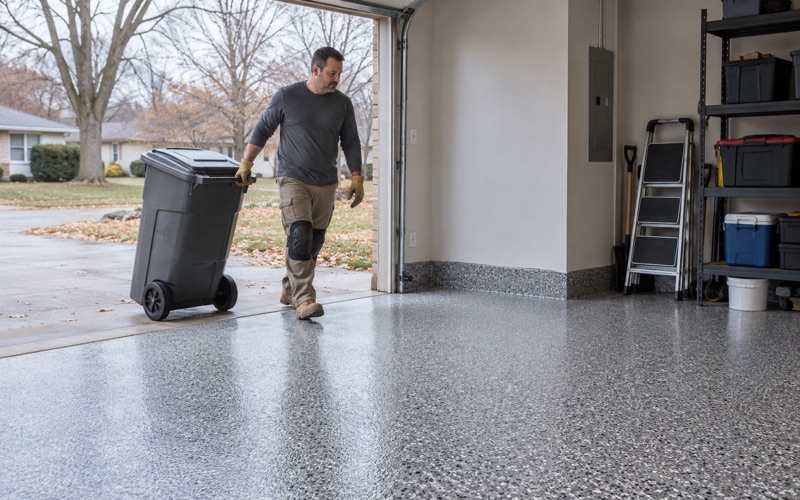
Vinyl flake floors are a fine choice in a garage, but they are a poor one on a press floor. The flakes give the eye so much to look at that a scatter of pellets disappears into the pattern. On a floor that is inspected visually, one solid color with a fine, even texture is easier to keep clean and easier to check.
Prep, joints and moisture before any of it
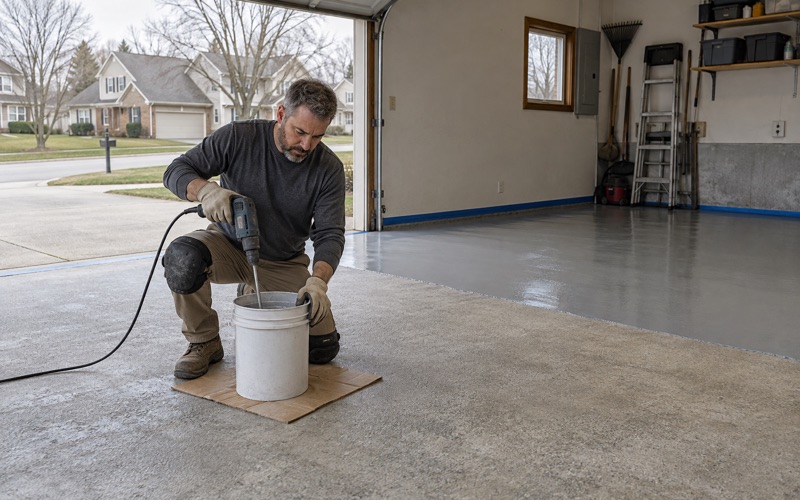
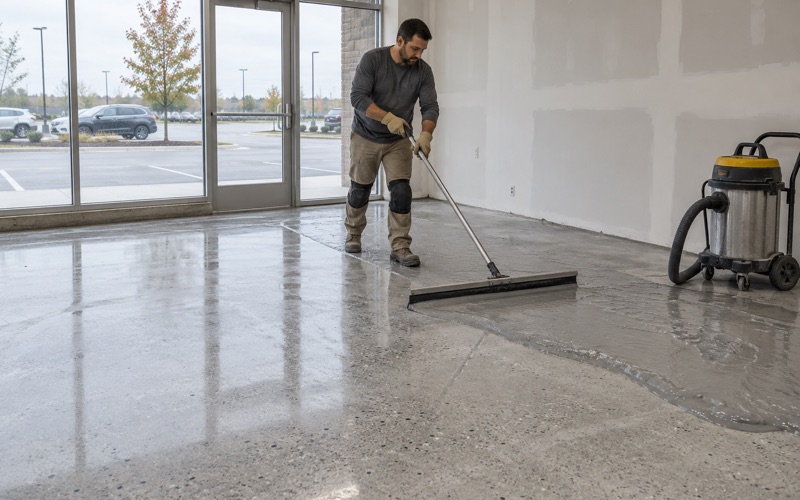
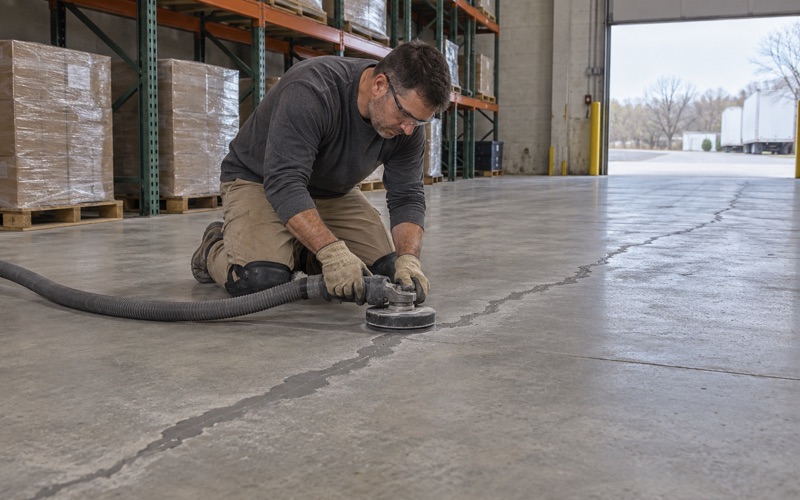
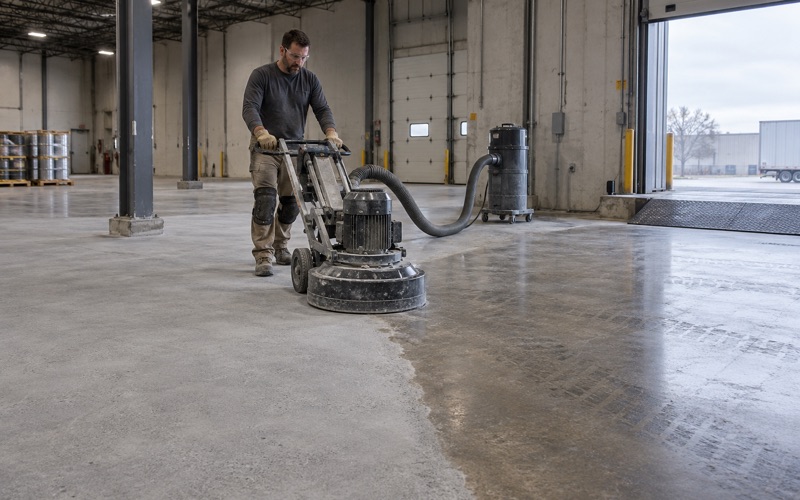
None of that texture holds on a slab that was not opened first. We grind every floor with diamond tooling or shot blast it to the ICRI surface profile the system calls for, and we do not acid etch. On a plant floor with years of mold release and oil soaked into it, mechanical prep is the only way to reach concrete a coating can bond to.
Control joints and the seams where an addition meets an older slab get a semirigid joint filler before any coating goes over them. Forklift and cart wheels hammer an unfilled joint edge until it spalls, and a broken joint edge is a lip and a pellet trap at the same time. A filled joint lets the coating run across it as one continuous surface.
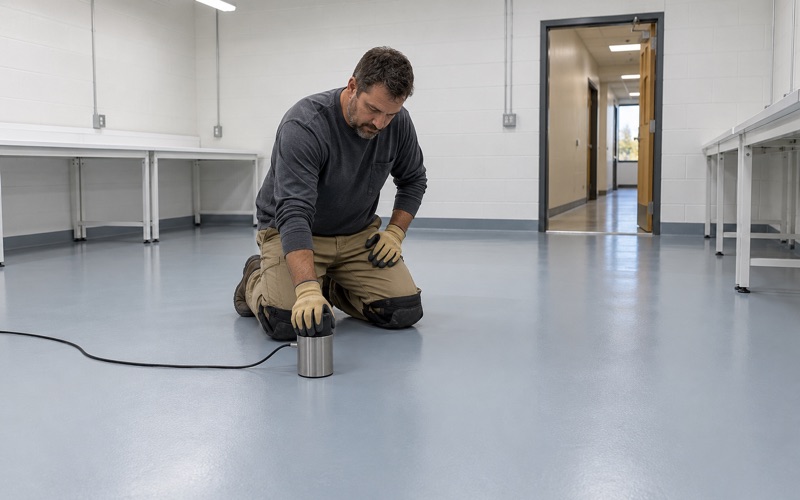
Moisture testing is a line item in our scope rather than an afterthought, because a slab that looks dry can still be pushing vapor up from below. We run ASTM F2170 in-situ relative humidity probes or ASTM F1869 calcium chloride tests, depending on the slab, and when readings call for it we specify a moisture-mitigation primer. Moisture from below is the first exclusion we read out of a warranty before a job is sold.
Packing, Warehouse and Plant Questions in Whitewater
The packing and storage side of a molding plant should be treated as its own zone, not an extension of the press floor. The traffic is different, the debris is different, and the people walking it are often different. We lay that zone out separately so each part of the building gets the floor its work calls for.
Laying out the packing and storage zone
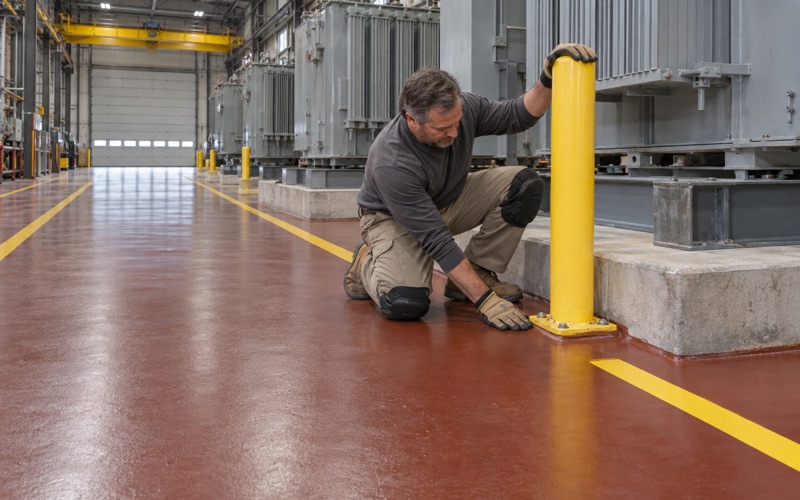
Packing lines and warehouse aisles see more wheels than boots. Pallet jacks and forklifts favor a smoother, harder finish that rolls easily and sweeps clean of cardboard dust and stray wrap, so we usually run a lower-texture build there. Painted aisle lines and color changes at the zone boundary show where the press floor ends and where forklift traffic begins.
Where the warehouse meets a dock door, the slab takes Wisconsin weather on the tires: snow melt, road salt and calcium chloride brine tracked in from the yard. We build those entries the way we build a garage floor for winter, with a topcoat that resists deicer and a slightly heavier texture at the threshold, then step down to the warehouse finish a few feet in.
Scheduling around three shifts
A plant that recruits operators on three shifts does not have a quiet night to give up. We plan plant, shop and warehouse floors around the hours the building has to keep running, working zone by zone over weekends and overnight windows so presses on one side keep cycling while the other side is ground, coated and cured.
Curing follows the slab, not the calendar. We check slab temperature and the dew point spread at the surface before each coat, because a coat laid down too close to dew point can blush and lose adhesion. A climate-controlled building helps, but loading dock zones near open doors still need watching in a Wisconsin winter.
What we ask before quoting
Before we price a Whitewater plant floor, we want to know which areas run presses, which handle packing and which store finished goods, plus what spills on each one. We also ask about the age of each slab section, any additions, and whether the floor has been coated before. Those answers set the zones, the textures and how many weekends the work will take.
Grinding dust and slurry are collected on site and never washed into a floor drain or a storm sewer, which matters in any building with floor drains in the work area. The result is a written scope that lays out each zone, its system and its thickness, and a floor built to stay clean, orderly and free of loose pellets between inspections.
- 20+ Years Coating Concrete
- Moisture Testing in Every Scope
- Written Contract Before Any Deposit